

The Essential Yet Most Overlooked Skills of the Successful Nonprofit Leader
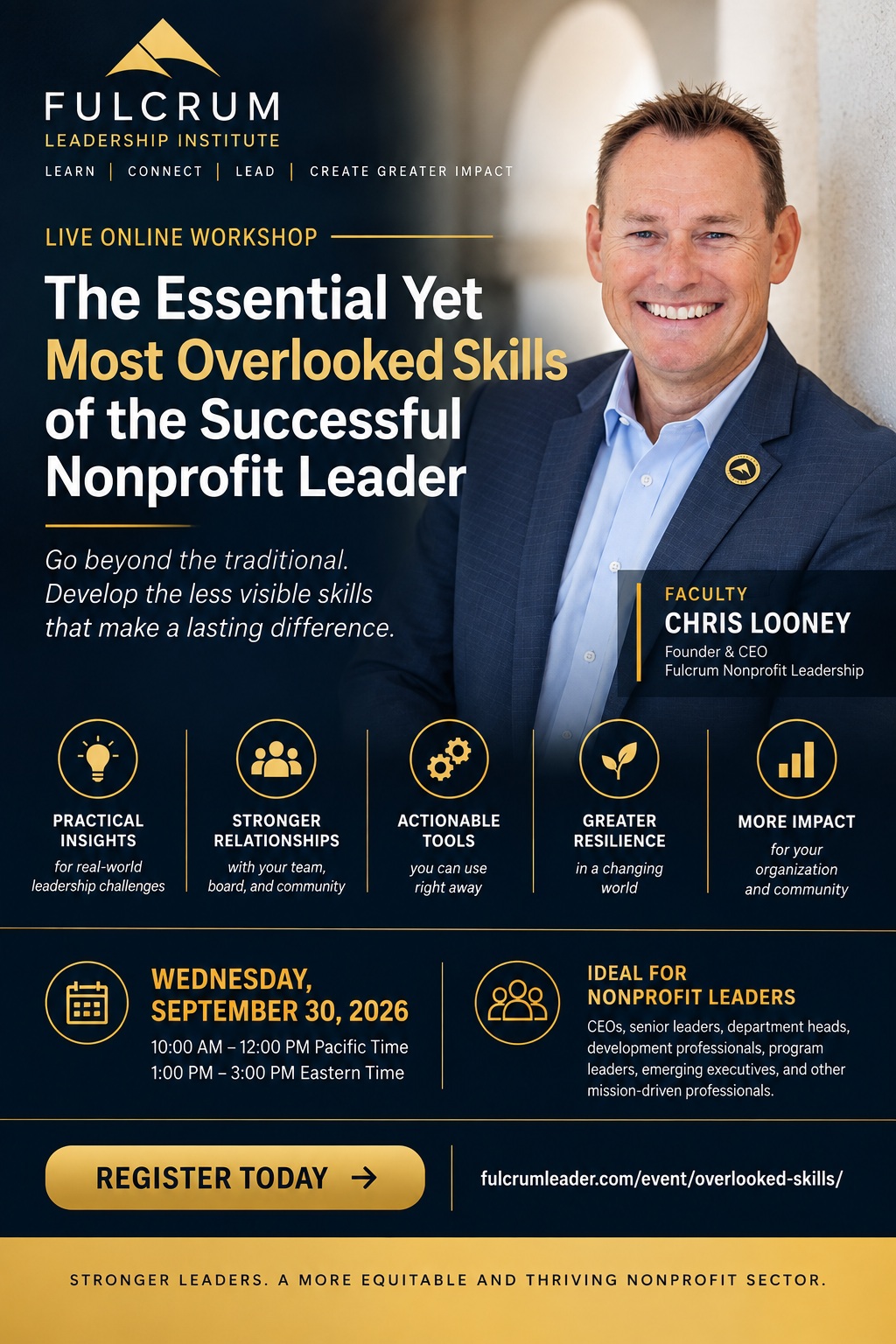
The Essential Yet Most Overlooked Skills of the Successful Nonprofit Leader
September 30, 2026 | 10:00 AM to 12:00 PM Pacific Time
Faculty: Chris Looney, Founder & CEO, Fulcrum Nonprofit Leadership
Fulcrum Leadership Institute
Fundraising. Strategic planning. Communication. Financial management. These are the skills we typically associate with successful nonprofit leadership. But some of the capabilities that most distinguish exceptional leaders rarely appear in a job description or leadership development program.
The Essential Yet Most Overlooked Skills of the Successful Nonprofit Leader is a practical, interactive two-hour Fulcrum Leadership Institute course focused on the less obvious leadership competencies that can have an outsized impact on organizational effectiveness and long-term success.
Based on Fulcrum’s white paper of the same name, the course will explore ten often-overlooked dimensions of nonprofit leadership, including emotional intelligence, resilience and adaptability, cultural competence, innovative thinking, systems thinking, personal branding, decision-making under uncertainty, ethical leadership, self-care and well-being, and community engagement.
Participants will examine why these skills matter, how they show up in the everyday realities of nonprofit leadership, and where they may have opportunities to strengthen their own leadership practice. The session will move beyond theory to consider practical ways leaders can build stronger relationships, navigate ambiguity, make better decisions, foster innovation, sustain themselves through challenging periods, and increase their influence inside and outside their organizations.
Key Learnings
By the end of this course, participants will be better equipped to:
- Recognize the overlooked skills that influence leadership effectiveness and understand why technical expertise alone is not enough to lead a successful nonprofit.
- Strengthen emotional intelligence and empathy to build trust, manage relationships, navigate conflict, and lead people more effectively.
- Develop greater resilience and adaptability to respond productively to setbacks, uncertainty, organizational change, and unexpected challenges.
- Apply cultural competence and systems thinking to better understand people, communities, organizational dynamics, and the interconnected consequences of leadership decisions.
- Cultivate innovative thinking and create conditions that encourage creativity, experimentation, and new approaches to persistent organizational challenges.
- Make better decisions when information is incomplete, balancing risk, opportunity, judgment, and organizational priorities.
- Understand the role of personal brand, relationships, and professional networks in expanding a leader’s credibility, influence, and ability to advance the mission.
- Practice ethical leadership by approaching difficult decisions with integrity, transparency, fairness, and consistency.
- Recognize self-care and well-being as leadership disciplines that contribute to sustained effectiveness and help prevent burnout.
- Strengthen community engagement by developing meaningful relationships with stakeholders and ensuring organizational priorities remain connected to community needs.
Who Should Attend
This course is designed for nonprofit executives, senior leaders, department heads, development professionals, program leaders, emerging executives, and other mission-driven professionals who want to expand their leadership capabilities beyond the traditional skills associated with managing a nonprofit organization.
It will be particularly valuable for leaders who are taking on greater responsibility, navigating organizational growth or change, managing increasingly complex relationships, preparing for executive leadership, or simply looking for practical ways to become more thoughtful, adaptable, resilient, and effective.
Great nonprofit leadership requires more than knowing how to run an organization. It requires developing the less visible skills that determine how you lead when the answers are not obvious, circumstances are changing, and the stakes are high.