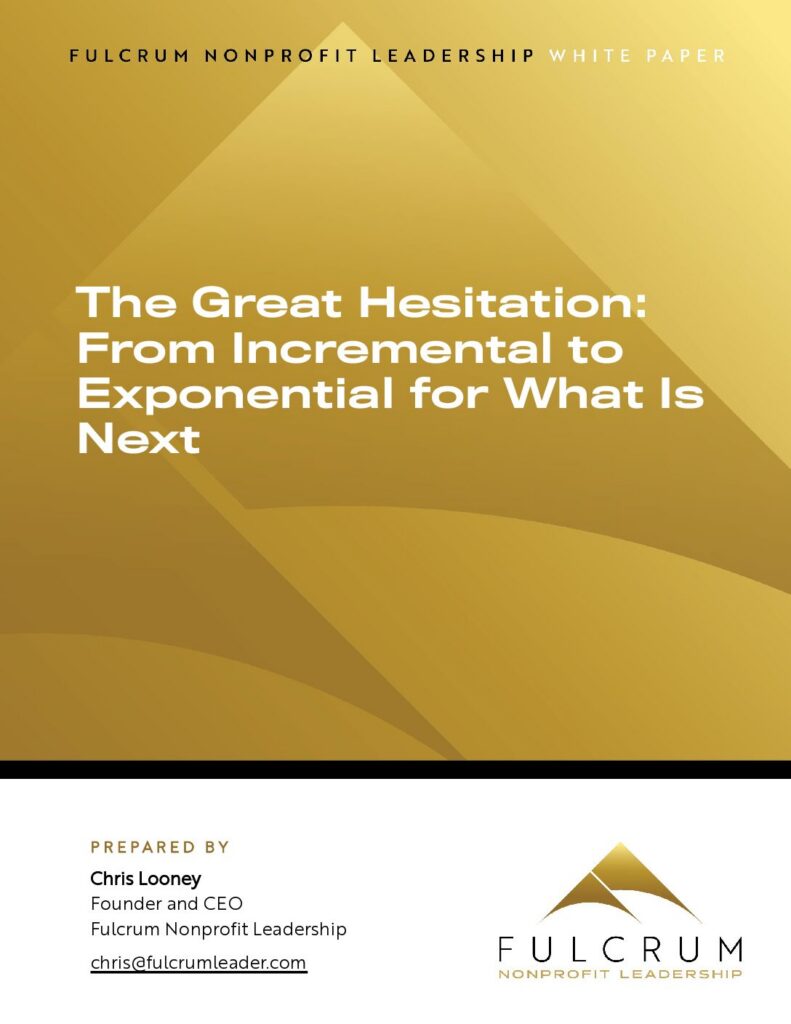
The Great Hesitation: From Incremental to Exponential for What Is Next
Nonprofit leadership is facing a defining moment. Funding landscapes are shifting. Political environments are volatile. Community needs are intensifying. Technology is advancing at unprecedented speed. Capital is available in new and creative forms. Yet amid this movement, many nonprofit leaders are hesitating.
They are cautious. They are waiting. They are making small adjustments instead of bold moves. This is the Great Hesitation. It is not born of apathy. It is born of uncertainty, fatigue, and a deep desire to protect the mission. But in a moment that demands acceleration, incremental thinking is no longer sufficient.
Nonprofits that continue to rely primarily on incremental actions risk falling behind the pace of change. Leaders must intentionally shift from an incremental mindset to an exponential mindset if they are to meet the demands of this era.
Futurist Leadership: Preparing Nonprofit Organizations for What is Next
The pace of change facing nonprofit organizations has accelerated dramatically. Technological disruption, demographic shifts, workforce transformation, funding volatility, and rising community expectations require leaders who can do more than manage the present. They must prepare their organizations for what is emerging. The Futurist Leader is not a predictor of trends. Rather, this leader builds the internal capacity to adapt, respond, and thrive in uncertain conditions.
The Seven C’s: The Key Characteristics That Cannot Be Trained
When organizations discuss hiring emerging leaders, the conversation typically centers on credentials, technical skills, and prior experience. Those elements matter. But they are also the easiest things to develop. Skills can be trained. Experience can be gained. Technical knowledge can be taught. What is far more difficult, and in many cases impossible, to manufacture through training are the core characteristics that shape how someone shows up every day. Over decades of observing leadership trajectories in nonprofit and mission driven organizations, one pattern is clear: the most effective emerging leaders consistently demonstrate seven foundational characteristics. These characteristics cannot be installed through a workshop. They cannot be grafted on through policy manuals. They come from within.
Venture Philanthropy Is Not the Future of Fundraising: It Is a New Category Within It
Venture philanthropy is often described as the future of fundraising. It is not. It will not replace annual giving. It will not eliminate major gifts. It will not render campaigns obsolete. But it is fundamentally different from traditional major gift fundraising. And it deserves to be understood, staffed, structured, and led as its own distinct fundraising discipline. Nonprofits that fail to make this distinction risk misalignment, burnout, and confusion. Those that do make the distinction position themselves for transformational growth.
Click the button below to download the full white paper.
Manager vs. Leader: A Critical Distinction for Nonprofit Effectiveness
Nonprofit organizations depend on strong management. Budgets must balance, programs must run, grants must be reported, and compliance requirements must be met. Yet many nonprofits struggle not because of a lack of management, but because leadership has been overshadowed by it.
While management and leadership are closely related, they are not the same. Understanding the distinction between the two is essential for nonprofit executives, senior teams, and emerging leaders who want to increase their impact.
Management focuses on stability, consistency, and execution. Leadership focuses on direction, meaning, and influence. Healthy nonprofits need both, but they do not benefit when the roles are confused or when leadership work is neglected.
The Overlooked Marketing Asset: Using the Form 990 Strategically
For many nonprofit leaders, the Form 990 is viewed as a compliance obligation. It is something to file accurately, on time, and then archive until the next year. In reality, the 990 is one of the most visible, credible, and underutilized marketing tools available to nonprofit organizations. It is often the first document donors, journalists, foundations, and regulators review when evaluating an organization. Whether leaders intend it or not, the 990 tells a story.
When nonprofits approach the 990 strategically, it becomes a powerful vehicle for building interest, confidence, transparency, and trust. It also provides an opportunity to educate board members about their fiduciary responsibilities and empower them as informed ambassadors for the organization.
Culture is Leadership’s Highest Responsibility
This white paper explores why culture matters so deeply in nonprofit organizations, why responsibility for culture rests squarely with leadership, and how nonprofit leaders can intentionally build and sustain positive, productive cultures.
Blind Spots as the Primary Arena for Nonprofit Leadership Growth
This white paper explores common blind spots among nonprofit leaders, practical ways to identify them, and proven methods for overcoming them in service of mission, people, and long-term sustainability.
Decision Making with Integrity: How Nonprofit Leaders Lead with Authenticity, Vision, and Shared Responsibility
Decision making sits at the heart of nonprofit leadership. Unlike command-and-control environments, nonprofit leaders operate within ecosystems shaped by mission, values, trust, and accountability to many stakeholders. The most effective decisions are not simply efficient or decisive. They are principled, inclusive, and aligned with purpose.
Bloom Where You Are Planted

Nonprofit leadership is rarely lived at the extremes. Most leaders are not trapped in impossible circumstances with no room to move, and they are not operating in environments where every condition is ideal for rapid organizational growth. Instead, leaders spend most of their time in the middle space, where conditions are mixed, constraints are real, and yet meaningful progress is still possible. This is where the philosophy of blooming where you are planted becomes both a mindset and a disciplined practice.
This philosophy does not promise magic. Leaders cannot escape structural realities, financial pressures, or systemic challenges through pure force of will. But it also rejects the fatalistic idea that progress requires perfect soil, abundant sun, or a flawless environment. Growth happens because leaders cultivate it with patience, intention, and the willingness to take the small wins seriously. With the right approach, even imperfect conditions can become fertile ground for improvement.