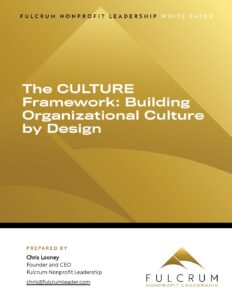
Building Organizational Culture by Design
A White Paper for Fulcrum Nonprofit Leadership
Every organization has a culture. The question is whether that culture has been intentionally created or simply allowed to emerge.
Culture is the collection of shared values, behaviors, expectations, beliefs, and unwritten rules that determine how work actually gets done. It influences how people communicate, make decisions, handle conflict, respond to change, treat one another, and ultimately advance the mission.
For nonprofit organizations, culture is particularly important. Our missions depend on people. Staff, board members, volunteers, donors, and community partners all experience the organization through its culture. A strong culture can multiply their commitment and effectiveness. A weak culture can undermine even the strongest strategy.
Culture is not what an organization hopes to become. Culture is what people experience every day.
Culture Is a Leadership Responsibility
Culture does not live in a mission statement, employee handbook, or list of organizational values. It is created through behavior repeated over time.
Leaders shape culture through what they model, communicate, reward, tolerate, and ignore. Every decision sends a signal about what really matters.
That makes every leader a culture carrier.
The Fulcrum CULTURE Framework provides seven leadership practices for intentionally creating and sustaining a healthy organizational culture:
C | Create Trust
Trust is the foundation. Leaders build it through consistency, honesty, transparency, competence, listening, fairness, and following through on commitments.
U | Understand Through Communication
Healthy cultures communicate openly and consistently. Leaders listen as intentionally as they speak and create opportunities for people to understand not only what is happening, but why.
L | Lead with Recognition and Accountability
People need to know when they are succeeding and when expectations are not being met. Strong cultures combine appreciation with accountability.
T | Tie Everyone to the Mission
People are more engaged when they understand how their work contributes to something larger than themselves. Leaders continually connect individual roles and organizational decisions to mission.
U | Unify Around Shared Values
Values become meaningful only when they influence behavior. Healthy organizations translate stated values into expectations for how people work, lead, decide, and interact.
R | Respond Well During Change
Culture is often revealed most clearly during uncertainty. How leaders communicate, listen, make decisions, and support people through change can either strengthen or erode the culture.
E | Evaluate and Improve Continuously
Culture is never finished. Leaders must regularly listen, assess, learn, and adjust as the organization and its people evolve.
Culture by Design
Strong cultures are not inherited. They are intentionally built.
Policies and programs matter, but culture ultimately develops through thousands of everyday interactions and leadership choices. That is why improving organizational culture almost always begins with improving leadership.
The CULTURE Framework challenges nonprofit leaders to move beyond asking, “What kind of culture do we want?”
The more important question is:
“What are we doing every day to create it?”
The Fulcrum Takeaway
Culture happens whether you manage it or not. Great nonprofit leaders refuse to leave something this important to chance. They create CULTURE by design.
For more information about Fulcrum Nonprofit Leadership, please visit our website at www.fulcrumleader.com or reach out to us directly via email at hello@fulcrumleader.com.