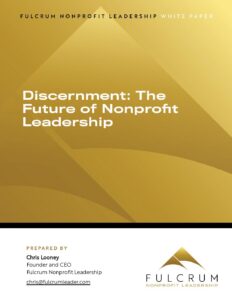
A White Paper for Fulcrum Nonprofit Leadership
Why the Rise of Artificial Intelligence Makes Human Judgment More Important Than Ever
The future of nonprofit leadership will not be defined simply by what leaders know, how quickly they respond, or how effectively they leverage technology.
Increasingly, it will be defined by their capacity for discernment.
Discernment is the leadership discipline of distinguishing what matters from what merely demands attention, evaluating competing priorities, and determining the most appropriate course of action. It requires wisdom, perspective, intentionality, and the courage to make difficult choices.
For nonprofit leaders, discernment has always been essential. Every day brings competing demands involving mission, money, people, priorities, and organizational sustainability. Rarely are these decisions straightforward. Often, leaders must choose not between right and wrong, but between competing goods.
The emergence of artificial intelligence makes this leadership competency even more consequential.
When Intelligence Is Abundant, Judgment Becomes Invaluable
Artificial intelligence is fundamentally changing how leaders access information, analyze challenges, develop strategies, and evaluate opportunities. Tasks that once required considerable time and specialized expertise can increasingly be accomplished in minutes.
But greater access to intelligence does not automatically produce better decisions.
AI can identify patterns, generate recommendations, and illuminate possibilities. It can help leaders understand what could be done. But determining what should be done remains a fundamentally human responsibility.
The competitive advantage of tomorrow’s nonprofit leader will not necessarily be knowing more. It will be knowing what matters more.
As technology accelerates the pace of decision-making, leaders risk confusing speed with effectiveness, activity with progress, and technological capability with organizational necessity.
Discernment provides the essential counterbalance.
The DISCERNMENT Framework
Discernment is not simply an intuitive gift possessed by exceptional leaders. It is a discipline that can be intentionally developed and consistently practiced.
The DISCERNMENT Framework offers nonprofit leaders a practical approach to navigating complexity and making thoughtful, mission-aligned decisions.
D | Define the Question
Before pursuing solutions, clarify the actual decision that needs to be made. Are we addressing the underlying challenge or merely responding to its symptoms? The quality of our decisions often depends on the quality of our questions.
I | Identify What Matters
Distinguish what is important from what is merely urgent. Consider the organization’s mission, values, strategic priorities, and long-term interests. Not everything that demands attention deserves investment.
S | Seek Perspective
Discernment rarely happens in isolation. Engage colleagues, board members, stakeholders, and individuals whose experiences or expertise challenge your thinking. AI can contribute valuable analysis, but it should complement rather than replace human perspective.
C | Consider the Consequences
Evaluate both immediate and longer-term implications. Who benefits? Who might be adversely affected? What unintended consequences could emerge? Nonprofit leaders must consider not only organizational outcomes but also the people and communities their decisions affect.
E | Examine Your Assumptions
Challenge what you believe to be true. Recognize personal biases, organizational traditions, incomplete information, and the limitations of AI-generated recommendations. Confidence is not necessarily evidence of correctness.
R | Recognize the Moment
Determine whether the circumstances call for action, additional information, patience, delegation, or a change in direction. Effective leadership requires understanding not only what to do, but when to do it.
N | Name the Decision
Discernment must ultimately lead to responsible action. Make the decision, communicate the rationale, accept accountability, and remain willing to adjust as new information emerges.
Discernment Is Not Indecision
One of the greatest misconceptions about discernment is that it slows leadership down.
Discernment is not endless deliberation, avoidance of responsibility, or the pursuit of universal agreement. Rather, it creates the clarity necessary for decisive and purposeful action.
Indecision delays responsibility. Discernment prepares us to exercise it well.
A discerning leader recognizes that not every opportunity should be pursued, not every problem requires immediate intervention, and not every technological advancement needs to be adopted.
Sometimes the most consequential leadership decision is knowing when to say no.
The Human Advantage in an AI-Driven Future
As AI becomes increasingly sophisticated, nonprofit leaders will face a paradox: The more capable our technology becomes, the more essential our humanity becomes.
Technology can accelerate analysis and execution, but it cannot assume moral responsibility for organizational decisions. Questions involving human dignity, ethical responsibility, community trust, donor relationships, and mission integrity demand more than computational capability.
They demand judgment.
This does not diminish the importance of AI. Quite the opposite. Leaders who combine technological fluency with disciplined discernment will be better positioned to capitalize on innovation while protecting the values and relationships that make their organizations effective.
The objective is not to choose between artificial intelligence and human judgment. It is to leverage both appropriately.
The Future Belongs to Discerning Leaders
The next generation of exceptional nonprofit leaders will need more than knowledge, experience, adaptability, and technological competence. They will need the capacity to navigate complexity without losing clarity, embrace innovation without abandoning purpose, and make difficult decisions without compromising their values.
Discernment is not simply another leadership skill. It is the discipline that helps leaders apply all their other capabilities wisely.
The future of nonprofit leadership will not belong to those with the most information, the most sophisticated technology, or the fastest answers. It will belong to those who possess the wisdom to distinguish what is possible from what is purposeful, what is urgent from what is important, and what can be done from what should be done.
That is the promise, and the responsibility, of discernment.
For more information about Fulcrum Nonprofit Leadership, please visit our website at www.fulcrumleader.com or reach out to us directly via email at hello@fulcrumleader.com.