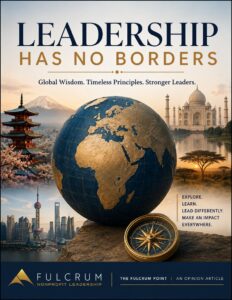
Walk into almost any American bookstore and browse the leadership section. The names will be familiar. We read American CEOs, professors, consultants, military leaders, coaches, and entrepreneurs.
There is tremendous wisdom there.
But there is also a problem.
Leadership is not an American invention, and America does not have a monopoly on understanding it.
Some of the most powerful leadership ideas in the world come from traditions many American leaders have never seriously explored.
Consider the Japanese concept of nemawashi. Literally rooted in the practice of preparing a tree before transplanting it, nemawashi describes the deliberate work of consulting people, listening, addressing concerns, and building support before a formal decision is made. The meeting is not where engagement begins. The groundwork has already been laid.
Think about how differently many of our organizations might function if leaders embraced that discipline.
Japan offers much more. Kazuo Inamori, founder of Kyocera and KDDI, built his management philosophy around an extraordinarily simple leadership question: What is the right thing to do as a human being? His philosophy emphasizes altruism, humility, purpose, and responsibility to others.
Travel to southern Africa and we encounter Ubuntu, a philosophy grounded in our shared humanity and interconnectedness. Leadership is not primarily about the elevation of the individual. It is about strengthening relationships, community, dignity, and collective flourishing. Nelson Mandela and Desmond Tutu helped introduce much of the world to its power.
India gives us Mahatma Gandhi’s extraordinary example of service, moral authority, simplicity, sacrifice, and nonviolent influence. The leadership tradition of the Tata organization, including Ratan Tata, similarly challenges the assumption that an enterprise exists principally for the enrichment of its owners. Leadership can place community, ethics, trust, and human dignity alongside organizational performance.
China’s Zhang Ruimin, longtime leader of Haier, challenged conventional hierarchy by pushing authority closer to employees and customers. Brazil’s Ricardo Semler questioned how much control leaders actually need. Dutch scholar Geert Hofstede transformed our understanding of how culture influences organizations. Fellow Dutch thinker Manfred Kets de Vries has pushed leaders to examine the psychology beneath leadership behavior.
These ideas do not need to replace American leadership thought.
They need to expand it.
There is something intellectually dangerous about assuming that what is familiar is superior. Foreign does not mean less relevant. Different does not mean less sophisticated. Sometimes another culture has spent generations developing language for a leadership principle we desperately need but have never learned to name.
Great leaders should be intellectually curious enough to cross borders.
Read Drucker and Greenleaf. Read Collins and Kouzes and Posner.
But then keep traveling.
Study Inamori. Explore nemawashi. Understand Ubuntu. Learn from Gandhi, Mandela, Tata, Zhang, Semler, Hofstede, and Kets de Vries.
Leadership wisdom belongs to humanity. Our development as leaders should be just as global.