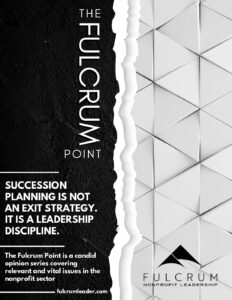
Succession Planning Is Not an Exit Strategy. It Is a Leadership Discipline.
In too many nonprofit organizations, succession planning begins when a leader announces their departure. A chief executive shares their timeline, the board scrambles to form a search committee, and the organization enters a period of uncertainty marked by urgency rather than intention. This reactive approach is common. It is also a missed opportunity.
Succession planning is not an event. It is not a document pulled off the shelf during a leadership transition. It is a discipline that should be embedded into how nonprofit organizations think about leadership, talent, and long-term sustainability. When succession planning is treated as an evergreen and strategic process, organizations are better positioned to navigate change without disruption, protect institutional knowledge, and develop leaders who are deeply aligned with mission and culture.
At its core, succession planning is about readiness, not replacement.
Leadership transitions are inevitable. People retire, move on, or step into new callings. What is not inevitable is the chaos that often accompanies those transitions. Organizations that view succession planning only as a response to departure tend to focus narrowly on filling a role. They ask who can step in quickly, rather than who has been intentionally prepared. This approach increases risk and often results in costly external searches that prioritize credentials over cultural and strategic fit.
An evergreen approach shifts the focus upstream.
Strategic succession planning begins with a clear understanding of the leadership the organization will need in the future, not just the roles it currently has. This requires boards and executives to think beyond titles and job descriptions and instead identify the competencies, behaviors, and perspectives that will be critical for the next phase of the organization’s life cycle. Growth, contraction, program evolution, and funding shifts all demand different leadership muscles.
Once those needs are understood, the real work begins.
Building leaders from within is not accidental. It requires deliberate investment in professional development, mentoring, and stretch opportunities. High potential staff must be identified early and given exposure to decision making, cross functional leadership, and strategic thinking. This does not mean promising promotions or creating artificial hierarchies. It means creating pathways for growth and visibility so future leaders are not a surprise to the organization or the board.
Internal leadership development also protects something that is often undervalued during transitions: institutional memory. Leaders who have grown within an organization understand its culture, history, and relationships in ways that no external hire can replicate quickly. When internal candidates are part of a succession pipeline, transitions are smoother, trust is preserved, and momentum is less likely to stall.
Succession planning must also include clarity around process.
Boards and executives should have shared expectations about how leadership transitions will be handled long before one is imminent. This includes clarity about interim leadership, decision making authority, communication protocols, and the role of outgoing leaders. When these elements are defined in advance, organizations avoid the confusion and power vacuums that can undermine staff confidence and stakeholder trust.
Importantly, succession planning is not solely the board’s responsibility, nor is it solely the executive’s. It is a shared accountability. Boards must prioritize it as part of governance, not crisis management. Executives must view it as part of their legacy, not a threat to their relevance. Strong leaders do not fear being replaced.
They prepare others to lead well.
The organizations that navigate leadership transitions most effectively are rarely those with the biggest budgets or the most recognizable brands. They are the ones that treated succession planning as an ongoing strategy rather than an emergency response. They understood that leadership continuity is not about finding the next person, but about building the next generation.
Succession planning done well is quiet, intentional, and continuous. When the moment of transition finally arrives, it should feel less like a disruption and more like the natural next chapter in a well-prepared story.
For more information about Fulcrum Nonprofit Leadership, please visit our
website at www.fulcrumleader.com or reach out to us directly via email at
hello@fulcrumleader.com.