Fulcrum Point – Opinion – Artificial Intelligence Will Separate the Leaders from the Reckless
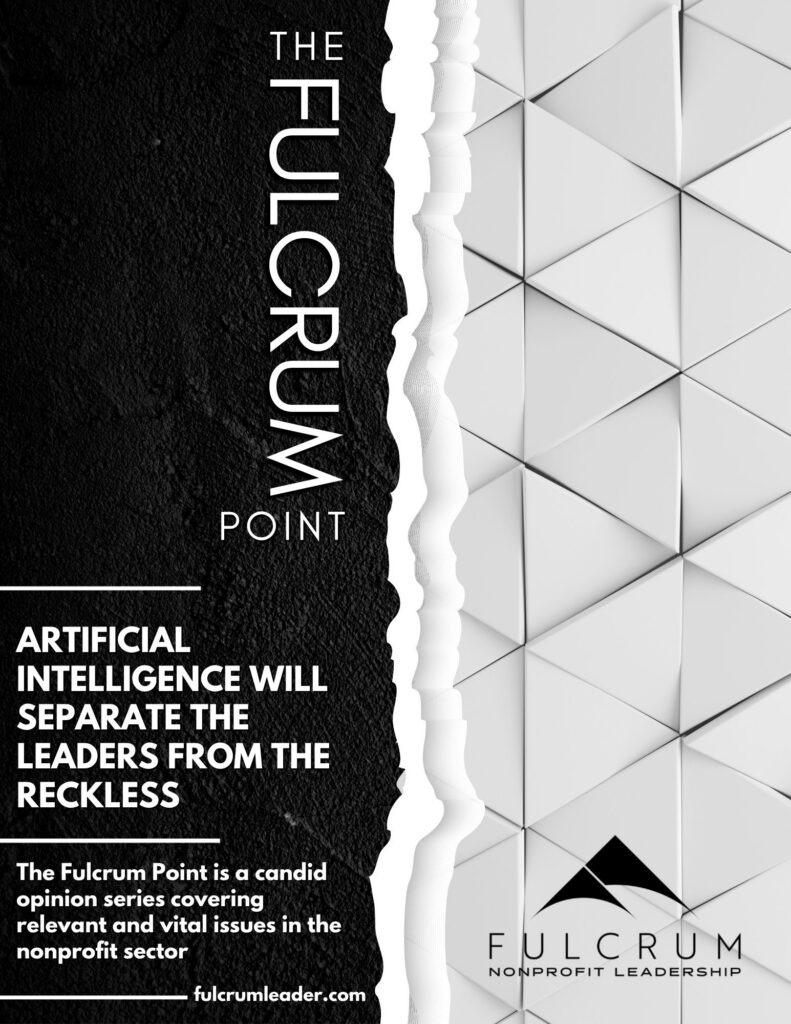
Artificial intelligence is no longer experimental in the nonprofit sector.
It has moved from optional to operational. What began as curiosity is now embedded in back office systems, donor communications, grant writing, financial forecasting, and program analytics. AI tools are shaping messaging, automating workflows, and influencing decision making at every level of the organization.
The question is no longer whether to use AI.
The question is whether leaders will use it responsibly.
Auto Draft
The Great Hesitation: From Incremental to Exponential for What Is Next
Nonprofit leadership is facing a defining moment. Funding landscapes are shifting. Political environments are volatile. Community needs are intensifying. Technology is advancing at unprecedented speed. Capital is available in new and creative forms. Yet amid this movement, many nonprofit leaders are hesitating.
They are cautious. They are waiting. They are making small adjustments instead of bold moves. This is the Great Hesitation. It is not born of apathy. It is born of uncertainty, fatigue, and a deep desire to protect the mission. But in a moment that demands acceleration, incremental thinking is no longer sufficient.
Nonprofits that continue to rely primarily on incremental actions risk falling behind the pace of change. Leaders must intentionally shift from an incremental mindset to an exponential mindset if they are to meet the demands of this era.
Fulcrum Point – Opinion – When Philanthropic Advisors Help and When They Harm
Philanthropic advisors are playing an increasingly influential role in the nonprofit ecosystem. For many donors and families, they provide real value. They bring structure to giving. They help clarify values. They conduct diligence. They introduce new ideas and organizations. At their best, they elevate strategy and increase impact. But as their influence grows, so do the risks. If we care about a healthy philanthropic marketplace, we must be honest about where advisory models can unintentionally distort it.
Futurist Leadership: Preparing Nonprofit Organizations for What is Next
The pace of change facing nonprofit organizations has accelerated dramatically. Technological disruption, demographic shifts, workforce transformation, funding volatility, and rising community expectations require leaders who can do more than manage the present. They must prepare their organizations for what is emerging. The Futurist Leader is not a predictor of trends. Rather, this leader builds the internal capacity to adapt, respond, and thrive in uncertain conditions.
The Fulcrum Point – Opinion – Transparency Is No Longer Optional
The era of trust-based philanthropy without evidence is ending. Funders and donors are asking sharper questions. What changed because of this investment? How efficiently are resources deployed? Who is accountable if outcomes fall short? How strong is the leadership team steering the work? These questions are not cynical. They are rational. Capital is becoming more disciplined. Expectations are rising. And the organizations that thrive will be those that embrace scrutiny rather than resist it.
The Seven C’s: The Key Characteristics That Cannot Be Trained
When organizations discuss hiring emerging leaders, the conversation typically centers on credentials, technical skills, and prior experience. Those elements matter. But they are also the easiest things to develop. Skills can be trained. Experience can be gained. Technical knowledge can be taught. What is far more difficult, and in many cases impossible, to manufacture through training are the core characteristics that shape how someone shows up every day. Over decades of observing leadership trajectories in nonprofit and mission driven organizations, one pattern is clear: the most effective emerging leaders consistently demonstrate seven foundational characteristics. These characteristics cannot be installed through a workshop. They cannot be grafted on through policy manuals. They come from within.
The Fulcrum Point – Opinion – We Need More Enterprises in Nonprofits
The nonprofit sector has a complicated relationship with money. For profit companies can be valued in the trillions while exploiting labor, extracting resources, and concentrating wealth. Markets applaud their scale. Investors celebrate their dominance. Yet when a nonprofit builds a billion-dollar endowment to sustain its mission for generations, critics question whether it is too rich. When an organization accumulates reserves to weather volatility, it is accused of hoarding. When it invests strategically, it is told it should simply spend more. The stigma is real. And it is not going away. Rather than waiting for cultural attitudes to change, nonprofit leaders must change their posture toward enterprise.
Download below to access the full opinion piece.
Venture Philanthropy Is Not the Future of Fundraising: It Is a New Category Within It
Venture philanthropy is often described as the future of fundraising. It is not. It will not replace annual giving. It will not eliminate major gifts. It will not render campaigns obsolete. But it is fundamentally different from traditional major gift fundraising. And it deserves to be understood, staffed, structured, and led as its own distinct fundraising discipline. Nonprofits that fail to make this distinction risk misalignment, burnout, and confusion. Those that do make the distinction position themselves for transformational growth.
Click the button below to download the full white paper.
The Fulcrum Point – Opinion – When Ambition Overtakes Mission, Everyone Loses
Ambition is not the enemy of nonprofit leadership. In fact, ambition is often what fuels growth, innovation, and impact. The desire to expand services, reach more people, increase revenue, and elevate an organization’s profile can be healthy and even necessary. The nonprofit sector needs leaders who think boldly and act decisively. But ambition untethered from mission is dangerous, and when it begins to overtake purpose, the very reason the organization exists is put at risk.
Click Below to Download the Full Article