The Fulcrum Point – Opinion – Succession Planning is Not an Exit Strategy. It is a Leadership Discipline.
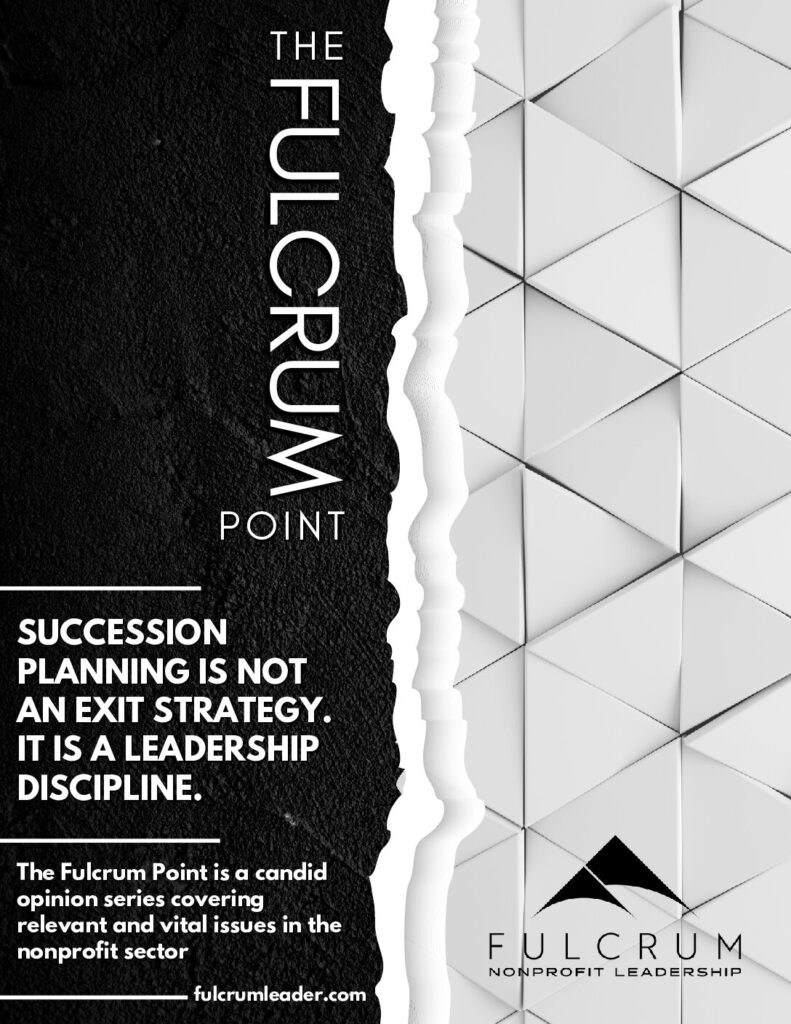
In too many nonprofit organizations, succession planning begins when a leader announces their departure. A chief executive shares their timeline, the board scrambles to form a search committee, and the organization enters a period of uncertainty marked by urgency rather than intention. This reactive approach is common. It is also a missed opportunity.
Succession planning is not an event. It is not a document pulled off the shelf during a leadership transition. It is a discipline that should be embedded into how nonprofit organizations think about leadership, talent, and long-term sustainability. When succession planning is treated as an evergreen and strategic process, organizations are better positioned to navigate change without disruption, protect institutional knowledge, and develop leaders who are deeply aligned with mission and culture.
At its core, succession planning is about readiness, not replacement.
The Overlooked Marketing Asset: Using the Form 990 Strategically
For many nonprofit leaders, the Form 990 is viewed as a compliance obligation. It is something to file accurately, on time, and then archive until the next year. In reality, the 990 is one of the most visible, credible, and underutilized marketing tools available to nonprofit organizations. It is often the first document donors, journalists, foundations, and regulators review when evaluating an organization. Whether leaders intend it or not, the 990 tells a story.
When nonprofits approach the 990 strategically, it becomes a powerful vehicle for building interest, confidence, transparency, and trust. It also provides an opportunity to educate board members about their fiduciary responsibilities and empower them as informed ambassadors for the organization.
Fulcrum Point – Opinion – Burnout is Real. Blame is Dangerous. Leadership Requires Ownership.
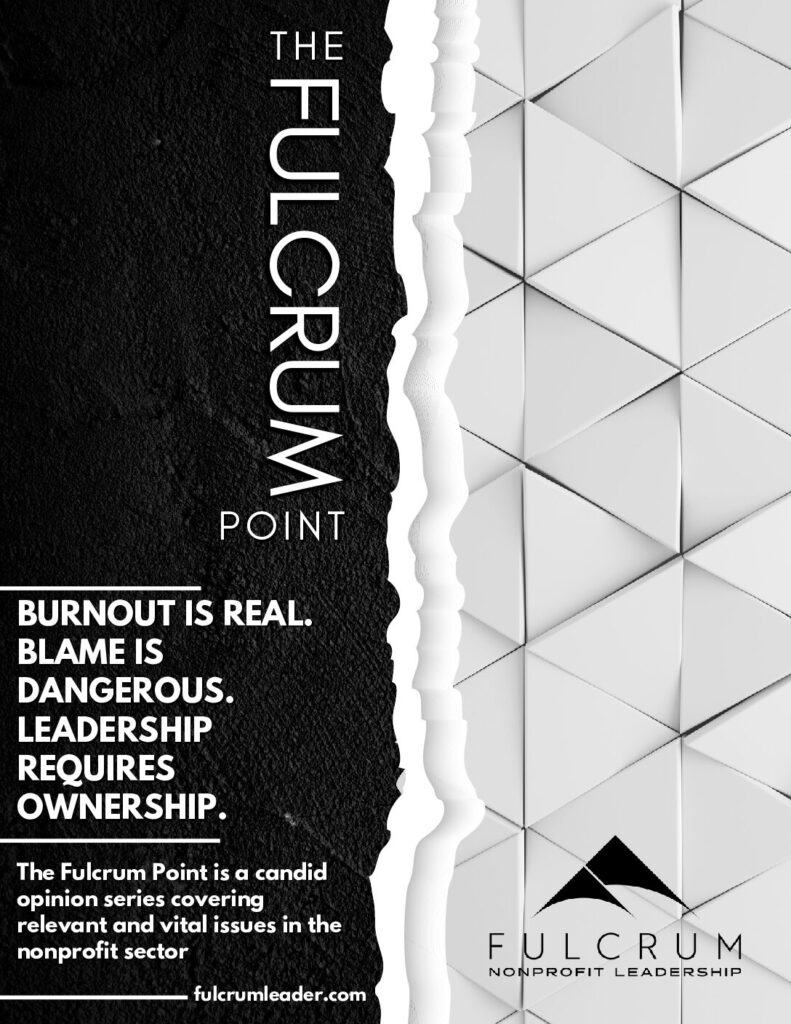
Burnout in the nonprofit sector is real. It is not imagined, exaggerated, or a convenient excuse. Nonprofit leaders and staff routinely carry heavy emotional loads, manage chronic resource constraints, and operate in environments where the needs always outpace capacity. Lean staffing, ambitious missions, and rising expectations can create sustained pressure that wears people down over time. Ignoring burnout would be irresponsible.
Culture is Leadership’s Highest Responsibility
This white paper explores why culture matters so deeply in nonprofit organizations, why responsibility for culture rests squarely with leadership, and how nonprofit leaders can intentionally build and sustain positive, productive cultures.
Fulcrum Point – Opinion – Revenue Diversification Is No Longer Optional. It Is a Survival Strategy.
For decades, many nonprofit organizations built their operating models around one primary source of revenue. For some, it was government funding. For others, it was individual major gifts, an annual signature event, or a single institutional funder. In stable economic periods, that approach could feel efficient and even prudent. In 2026, it will be reckless.
Blind Spots as the Primary Arena for Nonprofit Leadership Growth
This white paper explores common blind spots among nonprofit leaders, practical ways to identify them, and proven methods for overcoming them in service of mission, people, and long-term sustainability.
The Fulcrum Point – Opinion – The Peril and Responsibility of Negative Feedback
Delivering negative feedback is one of the most uncomfortable responsibilities of leadership. It is also one of the most essential.
In the nonprofit sector, where work is deeply personal and mission driven, feedback can feel especially fraught. A comment about communication style, professional appearance, effort, or focus can land not as guidance but as a judgment on character or commitment. And yet, avoiding these conversations does not make an organization kinder or healthier. It makes it weaker.
Nonprofit leaders are entrusted with stewarding mission, resources, and people in service of impact. That trust comes with an obligation to demand excellence. Not perfection, but excellence. The kind that ensures communities are served well, donors are respected, and staff are set up to succeed rather than quietly struggle.
Decision Making with Integrity: How Nonprofit Leaders Lead with Authenticity, Vision, and Shared Responsibility
Decision making sits at the heart of nonprofit leadership. Unlike command-and-control environments, nonprofit leaders operate within ecosystems shaped by mission, values, trust, and accountability to many stakeholders. The most effective decisions are not simply efficient or decisive. They are principled, inclusive, and aligned with purpose.
The Fulcrum Point – Opinion – Rebuilding the Modern Water Cooler
Leaders today must build the modern water cooler on purpose. Not a single
fixture but a network of small practices that give people the sense of community
that once happened automatically. When done well, these new water coolers do
more than fill a void. They help employees rediscover the power of connectivity,
the comfort of a shared home, and the quiet joy of belonging to a team that
celebrates, includes, and cares for one another.
Bloom Where You Are Planted

Nonprofit leadership is rarely lived at the extremes. Most leaders are not trapped in impossible circumstances with no room to move, and they are not operating in environments where every condition is ideal for rapid organizational growth. Instead, leaders spend most of their time in the middle space, where conditions are mixed, constraints are real, and yet meaningful progress is still possible. This is where the philosophy of blooming where you are planted becomes both a mindset and a disciplined practice.
This philosophy does not promise magic. Leaders cannot escape structural realities, financial pressures, or systemic challenges through pure force of will. But it also rejects the fatalistic idea that progress requires perfect soil, abundant sun, or a flawless environment. Growth happens because leaders cultivate it with patience, intention, and the willingness to take the small wins seriously. With the right approach, even imperfect conditions can become fertile ground for improvement.