Venture Philanthropy Is Not the Future of Fundraising: It Is a New Category Within It
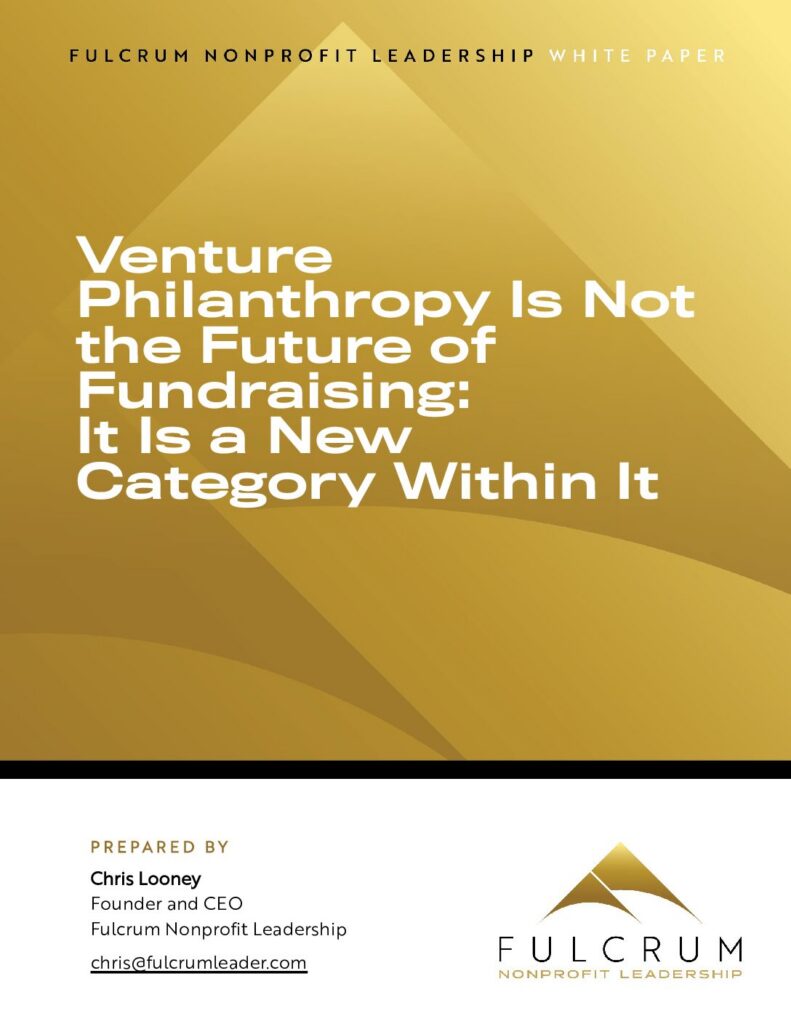
Venture philanthropy is often described as the future of fundraising. It is not. It will not replace annual giving. It will not eliminate major gifts. It will not render campaigns obsolete. But it is fundamentally different from traditional major gift fundraising. And it deserves to be understood, staffed, structured, and led as its own distinct fundraising discipline. Nonprofits that fail to make this distinction risk misalignment, burnout, and confusion. Those that do make the distinction position themselves for transformational growth.
Click the button below to download the full white paper.
Manager vs. Leader: A Critical Distinction for Nonprofit Effectiveness
Nonprofit organizations depend on strong management. Budgets must balance, programs must run, grants must be reported, and compliance requirements must be met. Yet many nonprofits struggle not because of a lack of management, but because leadership has been overshadowed by it.
While management and leadership are closely related, they are not the same. Understanding the distinction between the two is essential for nonprofit executives, senior teams, and emerging leaders who want to increase their impact.
Management focuses on stability, consistency, and execution. Leadership focuses on direction, meaning, and influence. Healthy nonprofits need both, but they do not benefit when the roles are confused or when leadership work is neglected.
The Overlooked Marketing Asset: Using the Form 990 Strategically
For many nonprofit leaders, the Form 990 is viewed as a compliance obligation. It is something to file accurately, on time, and then archive until the next year. In reality, the 990 is one of the most visible, credible, and underutilized marketing tools available to nonprofit organizations. It is often the first document donors, journalists, foundations, and regulators review when evaluating an organization. Whether leaders intend it or not, the 990 tells a story.
When nonprofits approach the 990 strategically, it becomes a powerful vehicle for building interest, confidence, transparency, and trust. It also provides an opportunity to educate board members about their fiduciary responsibilities and empower them as informed ambassadors for the organization.
Culture is Leadership’s Highest Responsibility
This white paper explores why culture matters so deeply in nonprofit organizations, why responsibility for culture rests squarely with leadership, and how nonprofit leaders can intentionally build and sustain positive, productive cultures.
Blind Spots as the Primary Arena for Nonprofit Leadership Growth
This white paper explores common blind spots among nonprofit leaders, practical ways to identify them, and proven methods for overcoming them in service of mission, people, and long-term sustainability.
Decision Making with Integrity: How Nonprofit Leaders Lead with Authenticity, Vision, and Shared Responsibility
Decision making sits at the heart of nonprofit leadership. Unlike command-and-control environments, nonprofit leaders operate within ecosystems shaped by mission, values, trust, and accountability to many stakeholders. The most effective decisions are not simply efficient or decisive. They are principled, inclusive, and aligned with purpose.
Bloom Where You Are Planted
Nonprofit leadership is rarely lived at the extremes. Most leaders are not trapped in impossible circumstances with no room to move, and they are not operating in environments where every condition is ideal for rapid organizational growth. Instead, leaders spend most of their time in the middle space, where conditions are mixed, constraints are real, and yet meaningful progress is still possible. This is where the philosophy of blooming where you are planted becomes both a mindset and a disciplined practice.
This philosophy does not promise magic. Leaders cannot escape structural realities, financial pressures, or systemic challenges through pure force of will. But it also rejects the fatalistic idea that progress requires perfect soil, abundant sun, or a flawless environment. Growth happens because leaders cultivate it with patience, intention, and the willingness to take the small wins seriously. With the right approach, even imperfect conditions can become fertile ground for improvement.
Servanthood in Nonprofit Leadership – Why it Matters and How to Cultivate It

In the nonprofit environment, leading through the lens of servanthood is far more than a pleasant aspiration; it is a strategic imperative. The concept of service-first leadership, often termed “servant leadership,” shifts the focus from authority and self-promotion toward empowering others, building capacity, and strengthening community. As nonprofit leaders, embracing this mindset enables your organization to better fulfill mission, enhance stakeholder trust, and sustain impact over time.
The Fulcrum Point – Opinion – Rethinking What Counts as Leadership
For decades, the nonprofit sector has been shaped by a hierarchy that privileges certain functions as “strategic” and others as “support.” Executive leadership, fundraising, and communications often sit at the top of that pyramid, while research, operations, data, and stewardship are relegated to the middle or bottom. It’s time to challenge that hierarchy. If our sector truly believes in collaboration, evidence-based decision-making, and mission alignment, then we must recognize that leadership exists in every corner of our organizations. Some of the most powerful leadership functions are hiding in plain sight — and one of the clearest examples is advancement research.
The Fulcrum Point – Opinion – Workplace Exodus: Why Talent is Walking Away and What to Do Now

The latest Fulcrum Point article, “Workplace Exodus: Why Nonprofit Talent Is Walking Away and What We Must Do Now,” examines the growing crisis of burnout, low pay, and inequity driving skilled professionals out of the nonprofit sector. It challenges leaders to move beyond surface solutions and rethink how organizations value and sustain their people. The piece calls for bold reforms in compensation, staffing, equity, and professional development, urging boards and executives to build workplaces where mission-driven talent can truly thrive.