The Fulcrum Point – Opinion – We Need More Enterprises in Nonprofits
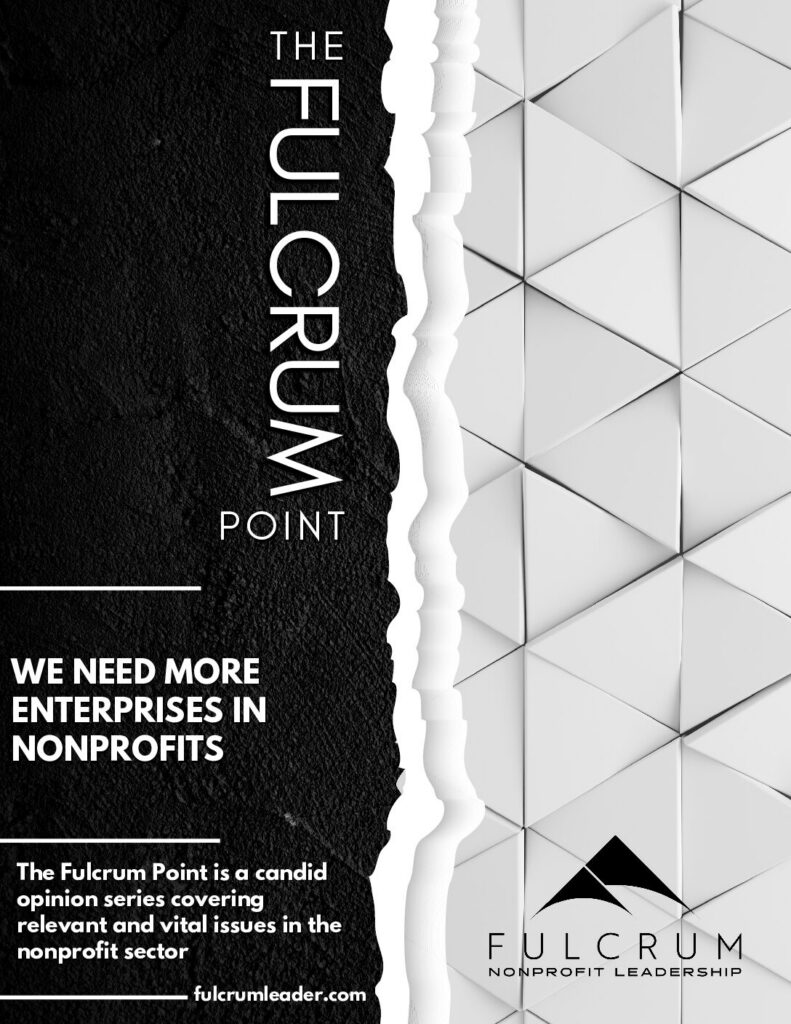
The nonprofit sector has a complicated relationship with money. For profit companies can be valued in the trillions while exploiting labor, extracting resources, and concentrating wealth. Markets applaud their scale. Investors celebrate their dominance. Yet when a nonprofit builds a billion-dollar endowment to sustain its mission for generations, critics question whether it is too rich. When an organization accumulates reserves to weather volatility, it is accused of hoarding. When it invests strategically, it is told it should simply spend more. The stigma is real. And it is not going away. Rather than waiting for cultural attitudes to change, nonprofit leaders must change their posture toward enterprise.
Download below to access the full opinion piece.
The Fulcrum Point – Opinion – When Ambition Overtakes Mission, Everyone Loses
Ambition is not the enemy of nonprofit leadership. In fact, ambition is often what fuels growth, innovation, and impact. The desire to expand services, reach more people, increase revenue, and elevate an organization’s profile can be healthy and even necessary. The nonprofit sector needs leaders who think boldly and act decisively. But ambition untethered from mission is dangerous, and when it begins to overtake purpose, the very reason the organization exists is put at risk.
Click Below to Download the Full Article
The Fulcrum Point – Opinion – Succession Planning is Not an Exit Strategy. It is a Leadership Discipline.
In too many nonprofit organizations, succession planning begins when a leader announces their departure. A chief executive shares their timeline, the board scrambles to form a search committee, and the organization enters a period of uncertainty marked by urgency rather than intention. This reactive approach is common. It is also a missed opportunity.
Succession planning is not an event. It is not a document pulled off the shelf during a leadership transition. It is a discipline that should be embedded into how nonprofit organizations think about leadership, talent, and long-term sustainability. When succession planning is treated as an evergreen and strategic process, organizations are better positioned to navigate change without disruption, protect institutional knowledge, and develop leaders who are deeply aligned with mission and culture.
At its core, succession planning is about readiness, not replacement.
Fulcrum Point – Opinion – Burnout is Real. Blame is Dangerous. Leadership Requires Ownership.
Burnout in the nonprofit sector is real. It is not imagined, exaggerated, or a convenient excuse. Nonprofit leaders and staff routinely carry heavy emotional loads, manage chronic resource constraints, and operate in environments where the needs always outpace capacity. Lean staffing, ambitious missions, and rising expectations can create sustained pressure that wears people down over time. Ignoring burnout would be irresponsible.
Fulcrum Point – Opinion – Revenue Diversification Is No Longer Optional. It Is a Survival Strategy.
For decades, many nonprofit organizations built their operating models around one primary source of revenue. For some, it was government funding. For others, it was individual major gifts, an annual signature event, or a single institutional funder. In stable economic periods, that approach could feel efficient and even prudent. In 2026, it will be reckless.
The Fulcrum Point – Opinion – The Peril and Responsibility of Negative Feedback
Delivering negative feedback is one of the most uncomfortable responsibilities of leadership. It is also one of the most essential.
In the nonprofit sector, where work is deeply personal and mission driven, feedback can feel especially fraught. A comment about communication style, professional appearance, effort, or focus can land not as guidance but as a judgment on character or commitment. And yet, avoiding these conversations does not make an organization kinder or healthier. It makes it weaker.
Nonprofit leaders are entrusted with stewarding mission, resources, and people in service of impact. That trust comes with an obligation to demand excellence. Not perfection, but excellence. The kind that ensures communities are served well, donors are respected, and staff are set up to succeed rather than quietly struggle.
The Fulcrum Point – Opinion – Rebuilding the Modern Water Cooler
Leaders today must build the modern water cooler on purpose. Not a single
fixture but a network of small practices that give people the sense of community
that once happened automatically. When done well, these new water coolers do
more than fill a void. They help employees rediscover the power of connectivity,
the comfort of a shared home, and the quiet joy of belonging to a team that
celebrates, includes, and cares for one another.
The Fulcrum Point – Opinion – When Philanthropy Comes Without Strings, Communities Win
Healthy philanthropy trusts nonprofit leaders to make the best decisions for their communities. It provides resources, clarity, and accountability, but does not attempt to steer the work from the outside. The most effective giving recognizes a simple truth. Nonprofit executives and boards know their missions, their clients, and their operational realities better than any outside donor ever could. When donors add layers of control that restrict how funds can be used, they are not advancing mission. They are advancing their own preferences, priorities, or public image. That is not philanthropy. It is something closer to private management of a public good, and it rarely creates lasting impact.
Creating Safe Spaces in Nonprofit Leadership
Nonprofit leaders operate in an environment shaped by mission, community expectations, social responsibility, and the desire to create lasting change. Yet many organizations still struggle to foster cultures where staff feel safe to speak honestly, share concerns, test new ideas, challenge the status quo, or admit when something is not working.
In a time when public discourse often rewards sharp edges and coarseness, nonprofit leadership must hold itself to a higher standard. The work is too important and the stakes too high for cultures where fear, hesitation, or silence become the norm.
Creating safe spaces is not a soft concept. It is a performance strategy. Psychological safety, which is the ability for individuals to express thoughts, questions, and even dissent without fear of embarrassment or retaliation, directly influences organizational health. When leaders establish safe spaces, they set the conditions for innovation, stronger teams, trust, resilience, and mission advancement.
The nonprofit sector is uniquely positioned to model the kind of leadership that values openness, integrity, accountability, and humility. This white paper outlines why safe spaces matter, how they strengthen organizations, and what leaders can do to create environments where people can bring their best thinking to the work.
The Fulcrum Point – Opinion – The Nonprofit Sector Cannot Exist Without Government Partnership
In public discourse, it is often said that the nonprofit sector stands as a pillar of civil society, sustained by the generosity of donors, the ingenuity of social entrepreneurs, and the selflessness of volunteers. While that image contains truth, it leaves out an indispensable partner: government. The nonprofit sector does not thrive in isolation, nor does it function effectively without a sustained public-private partnership. The history and future of the nonprofit world are deeply intertwined with government at every level. The idea that private philanthropy alone can meet the scale of human need is not only inaccurate but dangerously naive.