| Title | Summary | Downloads | hf:doc_categories | hf:doc_tags | ||
|---|---|---|---|---|---|---|
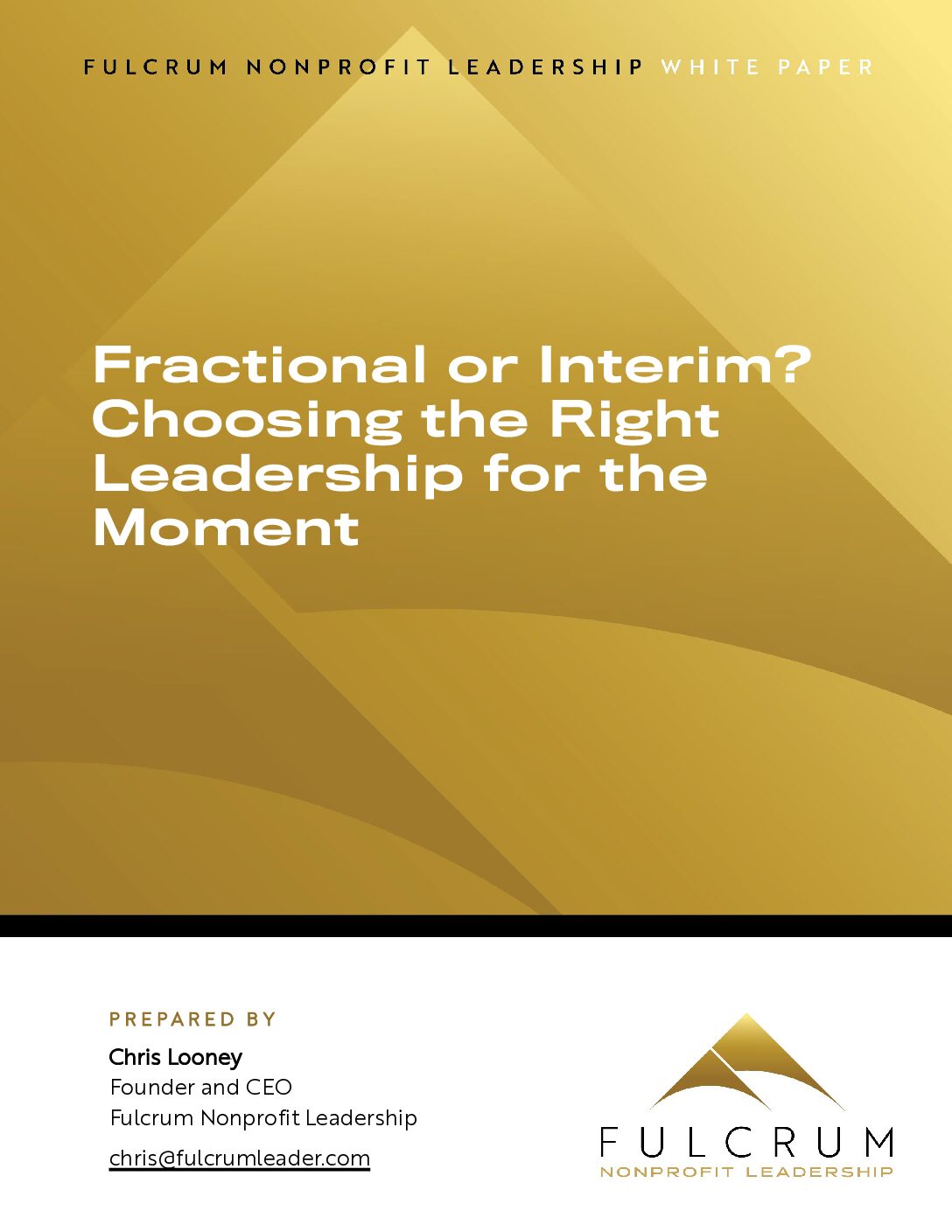 | Fractional or Interim? Choosing the Right Leadership for the Moment | Choosing the Right Leadership for the Moment A White Paper for Fulcrum Nonprofit Leadership Nonprofits … | 1 | leadership organization-development program-management | white-paper | |
 | It’s Not About Growth. It’s About Scaling | The Fulcrum Point – An Opinion Series The nonprofit sector loves growth. We celebrate bigger … | opinion organization-development professional-development program-management revenue-generation | opinion | ||
 | Permission to Fail: Creating Organizations Where People Have the Courage to Learn | A White Paper for Fulcrum Nonprofit Leadership Nonprofit leaders regularly ask their organizations to innovate. … | leadership organization-development professional-development | white-paper | ||
 | Leadership Has No Borders | Walk into almost any American bookstore and browse the leadership section. The names will be … | opinion | opinion | ||
 | Co-Creation: People Invest in What They Help Create | Nonprofit leaders spend considerable time thinking about engagement. How do we engage our board? How … | community-engagement organization-development professional-development staff-management volunteer-management | white-paper | ||
 | OVERHEAD IS FUEL – Stop Talking About Overhead as a Negative | For decades, the nonprofit sector has allowed one of its most damaging misconceptions to persist: … | financial-management leadership opinion | opinion | ||
 | Relationships Are the Currency of Nonprofit Leadership | A White Paper for Fulcrum Nonprofit Leadership Nonprofit leadership is fundamentally relational. Strategy matters. Financial … | building-relationships leadership | white-paper | ||
 | The Greatest Asset Is Already on Your Payroll | The Fulcrum Point – An Opinion Article Nonprofit leaders spend enormous amounts of time thinking … | mentorship professional-development staff-management | opinion | ||
 | Purpose-Driven Time Management – Managing the Leader’s Most Finite Resource | A White Paper for Fulcrum Nonprofit Leadership For-purpose leaders face a unique challenge: there is … | leadership | white-paper | ||
 | The Business Mindset Every For-Purpose Leader Must Embrace | The Fulcrum Point – An Opinion Article Words matter. The labels we use shape the … | 1 | free fundraising goal-setting opinion professional-development program-management staff-management strategic-planning | opinion | |
 | Culture by Design: Why Great Nonprofit Leaders Build Culture Intentionally | A White Paper for Fulcrum Nonprofit Leadership Introduction Organizational culture is often described as “the … | leadership organization-development | white-paper | ||
 | Clarity Is Not a Soft Skill. | It Is an Execution Strategy. Nonprofit leaders often assume execution problems stem from insufficient resources, … | communication leadership professional-development staff-management | white-paper | ||
 | More Trust, Less Turf: Why the CEO and CDO Relationship Determines Nonprofit Success | Every nonprofit has critical leadership relationships. The CEO and Board Chair. The CEO and CFO. … | 1 | leadership opinion organization-development staff-management | opinion | |
 | Force Multipliers: The Secret Behind High-Performing Nonprofit Organizations | One of the most important responsibilities of a nonprofit leader is building a team capable … | leadership organization-development professional-development recruitment staff-management | white-paper | ||
 | Fulcrum Point – Opinion – The Healthy Power of Pruning | One of the healthiest governance practices an organization can embrace is the disciplined pruning of its board through clear, consistent term limits and intentional off ramps for disengaged or unproductive members. | opinion | opinion | ||
 | AQ: Why Adaptability Quotient May Be the Most Important Leadership Trait of the Future | But another leadership trait is rapidly emerging as equally important, and perhaps even more essential for nonprofit leaders navigating today’s environment: Adaptability Quotient. Adaptability Quotient measures a leader’s ability to adjust, evolve, respond, and thrive amid changing circumstances. It is the capacity to remain effective when the environment becomes uncertain, unstable, disruptive, or entirely unfamiliar. And in the nonprofit sector, adaptability is no longer optional. | leadership organization-development professional-development | white-paper | ||
 | Fulcrum Point – Opinion – The Most Dangerous Addition in Nonprofit Leadership: Avoidance | There is an addiction quietly damaging nonprofit organizations every single day. It is not greed. It is avoidance. Avoidance is the hidden addiction of nonprofit leadership because it disguises itself as wisdom, patience, kindness, collaboration, discernment, and strategic caution. In reality, it is often fear wearing professional clothing. And while most nonprofit leaders would never describe themselves as avoidant, the evidence frequently tells another story. Avoidance shows up in delayed decisions. The longer avoidance is tolerated, the more expensive it becomes. | 1 | opinion professional-development | opinion | |
 | Stress Testing Your Organization Constantly is Key | Future-ready leaders understand an important truth: resilience is not built during a crisis. It is built before one arrives. That is why nonprofit leaders must embrace the discipline of constantly stress testing their organizations. Stress testing is the intentional process of evaluating how an organization would perform under pressure. It requires leaders to ask difficult questions before circumstances force the answers. Rather than assuming systems, funding models, staffing structures, or strategies will hold, stress testing examines where weaknesses exist and what could happen if key assumptions fail. The goal is not fear. The goal is preparation. | leadership organization-development strategic-planning | white-paper | ||
 | Fulcrum Point – Opinion – Artificial Intelligence Will Separate the Leaders from the Reckless | Artificial intelligence is no longer experimental in the nonprofit sector. It has moved from optional to operational. What began as curiosity is now embedded in back office systems, donor communications, grant writing, financial forecasting, and program analytics. AI tools are shaping messaging, automating workflows, and influencing decision making at every level of the organization. The question is no longer whether to use AI. The question is whether leaders will use it responsibly. | leadership opinion organization-development program-management | opinion | ||
 | The Great Hesitation: From Incremental to Exponential for What Is Next | Nonprofit leadership is facing a defining moment. Funding landscapes are shifting. Political environments are volatile. Community needs are intensifying. Technology is advancing at unprecedented speed. Capital is available in new and creative forms. Yet amid this movement, many nonprofit leaders are hesitating. They are cautious. They are waiting. They are making small adjustments instead of bold moves. This is the Great Hesitation. It is not born of apathy. It is born of uncertainty, fatigue, and a deep desire to protect the mission. But in a moment that demands acceleration, incremental thinking is no longer sufficient. Nonprofits that continue to rely primarily on incremental actions risk falling behind the pace of change. Leaders must intentionally shift from an incremental mindset to an exponential mindset if they are to meet the demands of this era. | leadership organization-development professional-development | white-paper | ||
 | Fulcrum Point – Opinion – When Philanthropic Advisors Help and When They Harm | Philanthropic advisors are playing an increasingly influential role in the nonprofit ecosystem. For many donors and families, they provide real value. They bring structure to giving. They help clarify values. They conduct diligence. They introduce new ideas and organizations. At their best, they elevate strategy and increase impact. But as their influence grows, so do the risks. If we care about a healthy philanthropic marketplace, we must be honest about where advisory models can unintentionally distort it. | fundraising opinion | opinion | ||
 | Futurist Leadership: Preparing Nonprofit Organizations for What is Next | The pace of change facing nonprofit organizations has accelerated dramatically. Technological disruption, demographic shifts, workforce transformation, funding volatility, and rising community expectations require leaders who can do more than manage the present. They must prepare their organizations for what is emerging. The Futurist Leader is not a predictor of trends. Rather, this leader builds the internal capacity to adapt, respond, and thrive in uncertain conditions. | leadership organization-development professional-development | white-paper | ||
 | The Fulcrum Point – Opinion – Transparency Is No Longer Optional | The era of trust-based philanthropy without evidence is ending. Funders and donors are asking sharper questions. What changed because of this investment? How efficiently are resources deployed? Who is accountable if outcomes fall short? How strong is the leadership team steering the work? These questions are not cynical. They are rational. Capital is becoming more disciplined. Expectations are rising. And the organizations that thrive will be those that embrace scrutiny rather than resist it. | financial-management fundraising opinion professional-development revenue-generation | opinion | ||
 | The Seven C’s: The Key Characteristics That Cannot Be Trained | When organizations discuss hiring emerging leaders, the conversation typically centers on credentials, technical skills, and prior experience. Those elements matter. But they are also the easiest things to develop. Skills can be trained. Experience can be gained. Technical knowledge can be taught. What is far more difficult, and in many cases impossible, to manufacture through training are the core characteristics that shape how someone shows up every day. Over decades of observing leadership trajectories in nonprofit and mission driven organizations, one pattern is clear: the most effective emerging leaders consistently demonstrate seven foundational characteristics. These characteristics cannot be installed through a workshop. They cannot be grafted on through policy manuals. They come from within. | professional-development recruitment staff-management | white-paper | ||
 | The Fulcrum Point – Opinion – We Need More Enterprises in Nonprofits | The nonprofit sector has a complicated relationship with money. For profit companies can be valued in the trillions while exploiting labor, extracting resources, and concentrating wealth. Markets applaud their scale. Investors celebrate their dominance. Yet when a nonprofit builds a billion-dollar endowment to sustain its mission for generations, critics question whether it is too rich. When an organization accumulates reserves to weather volatility, it is accused of hoarding. When it invests strategically, it is told it should simply spend more. The stigma is real. And it is not going away. Rather than waiting for cultural attitudes to change, nonprofit leaders must change their posture toward enterprise. Download below to access the full opinion piece. | financial-management leadership opinion organization-development strategic-planning | opinion | ||
 | Venture Philanthropy Is Not the Future of Fundraising: It Is a New Category Within It | Venture philanthropy is often described as the future of fundraising. It is not. It will not replace annual giving. It will not eliminate major gifts. It will not render campaigns obsolete. But it is fundamentally different from traditional major gift fundraising. And it deserves to be understood, staffed, structured, and led as its own distinct fundraising discipline. Nonprofits that fail to make this distinction risk misalignment, burnout, and confusion. Those that do make the distinction position themselves for transformational growth. Click the button below to download the full white paper. | fundraising | white-paper | ||
 | The Fulcrum Point – Opinion – When Ambition Overtakes Mission, Everyone Loses | Ambition is not the enemy of nonprofit leadership. In fact, ambition is often what fuels growth, innovation, and impact. The desire to expand services, reach more people, increase revenue, and elevate an organization’s profile can be healthy and even necessary. The nonprofit sector needs leaders who think boldly and act decisively. But ambition untethered from mission is dangerous, and when it begins to overtake purpose, the very reason the organization exists is put at risk. Click Below to Download the Full Article | 1 | opinion professional-development | opinion | |
 | Manager vs. Leader: A Critical Distinction for Nonprofit Effectiveness | Nonprofit organizations depend on strong management. Budgets must balance, programs must run, grants must be reported, and compliance requirements must be met. Yet many nonprofits struggle not because of a lack of management, but because leadership has been overshadowed by it. While management and leadership are closely related, they are not the same. Understanding the distinction between the two is essential for nonprofit executives, senior teams, and emerging leaders who want to increase their impact. Management focuses on stability, consistency, and execution. Leadership focuses on direction, meaning, and influence. Healthy nonprofits need both, but they do not benefit when the roles are confused or when leadership work is neglected. | organization-development professional-development program-management staff-management | white-paper | ||
 | The Fulcrum Point – Opinion – Succession Planning is Not an Exit Strategy. It is a Leadership Discipline. | In too many nonprofit organizations, succession planning begins when a leader announces their departure. A chief executive shares their timeline, the board scrambles to form a search committee, and the organization enters a period of uncertainty marked by urgency rather than intention. This reactive approach is common. It is also a missed opportunity. Succession planning is not an event. It is not a document pulled off the shelf during a leadership transition. It is a discipline that should be embedded into how nonprofit organizations think about leadership, talent, and long-term sustainability. When succession planning is treated as an evergreen and strategic process, organizations are better positioned to navigate change without disruption, protect institutional knowledge, and develop leaders who are deeply aligned with mission and culture. At its core, succession planning is about readiness, not replacement. | 1 | opinion | opinion | |
 | The Overlooked Marketing Asset: Using the Form 990 Strategically | For many nonprofit leaders, the Form 990 is viewed as a compliance obligation. It is something to file accurately, on time, and then archive until the next year. In reality, the 990 is one of the most visible, credible, and underutilized marketing tools available to nonprofit organizations. It is often the first document donors, journalists, foundations, and regulators review when evaluating an organization. Whether leaders intend it or not, the 990 tells a story. When nonprofits approach the 990 strategically, it becomes a powerful vehicle for building interest, confidence, transparency, and trust. It also provides an opportunity to educate board members about their fiduciary responsibilities and empower them as informed ambassadors for the organization. | communication fundraising | white-paper | ||
 | Fulcrum Point – Opinion – Burnout is Real. Blame is Dangerous. Leadership Requires Ownership. | Burnout in the nonprofit sector is real. It is not imagined, exaggerated, or a convenient excuse. Nonprofit leaders and staff routinely carry heavy emotional loads, manage chronic resource constraints, and operate in environments where the needs always outpace capacity. Lean staffing, ambitious missions, and rising expectations can create sustained pressure that wears people down over time. Ignoring burnout would be irresponsible. | opinion | opinion | ||
 | Culture is Leadership’s Highest Responsibility | This white paper explores why culture matters so deeply in nonprofit organizations, why responsibility for culture rests squarely with leadership, and how nonprofit leaders can intentionally build and sustain positive, productive cultures. | leadership professional-development | white-paper | ||
 | Fulcrum Point – Opinion – Revenue Diversification Is No Longer Optional. It Is a Survival Strategy. | For decades, many nonprofit organizations built their operating models around one primary source of revenue. For some, it was government funding. For others, it was individual major gifts, an annual signature event, or a single institutional funder. In stable economic periods, that approach could feel efficient and even prudent. In 2026, it will be reckless. | 1 | opinion | opinion | |
 | Blind Spots as the Primary Arena for Nonprofit Leadership Growth | This white paper explores common blind spots among nonprofit leaders, practical ways to identify them, and proven methods for overcoming them in service of mission, people, and long-term sustainability. | professional-development | white-paper | ||
 | The Fulcrum Point – Opinion – The Peril and Responsibility of Negative Feedback | Delivering negative feedback is one of the most uncomfortable responsibilities of leadership. It is also one of the most essential. In the nonprofit sector, where work is deeply personal and mission driven, feedback can feel especially fraught. A comment about communication style, professional appearance, effort, or focus can land not as guidance but as a judgment on character or commitment. And yet, avoiding these conversations does not make an organization kinder or healthier. It makes it weaker. Nonprofit leaders are entrusted with stewarding mission, resources, and people in service of impact. That trust comes with an obligation to demand excellence. Not perfection, but excellence. The kind that ensures communities are served well, donors are respected, and staff are set up to succeed rather than quietly struggle. | 1 | opinion | opinion | |
 | Decision Making with Integrity: How Nonprofit Leaders Lead with Authenticity, Vision, and Shared Responsibility | Decision making sits at the heart of nonprofit leadership. Unlike command-and-control environments, nonprofit leaders operate within ecosystems shaped by mission, values, trust, and accountability to many stakeholders. The most effective decisions are not simply efficient or decisive. They are principled, inclusive, and aligned with purpose. | leadership | white-paper | ||
 | The Fulcrum Point – Opinion – Rebuilding the Modern Water Cooler | Leaders today must build the modern water cooler on purpose. Not a single fixture but a network of small practices that give people the sense of community that once happened automatically. When done well, these new water coolers do more than fill a void. They help employees rediscover the power of connectivity, the comfort of a shared home, and the quiet joy of belonging to a team that celebrates, includes, and cares for one another. | 1 | opinion | opinion | |
 | Bloom Where You Are Planted | Nonprofit leadership is rarely lived at the extremes. Most leaders are not trapped in impossible circumstances with no room to move, and they are not operating in environments where every condition is ideal for rapid organizational growth. Instead, leaders spend most of their time in the middle space, where conditions are mixed, constraints are real, and yet meaningful progress is still possible. This is where the philosophy of blooming where you are planted becomes both a mindset and a disciplined practice. This philosophy does not promise magic. Leaders cannot escape structural realities, financial pressures, or systemic challenges through pure force of will. But it also rejects the fatalistic idea that progress requires perfect soil, abundant sun, or a flawless environment. Growth happens because leaders cultivate it with patience, intention, and the willingness to take the small wins seriously. With the right approach, even imperfect conditions can become fertile ground for improvement. | leadership professional-development | white-paper | ||
 | The Fulcrum Point – Opinion – When Philanthropy Comes Without Strings, Communities Win | Healthy philanthropy trusts nonprofit leaders to make the best decisions for their communities. It provides resources, clarity, and accountability, but does not attempt to steer the work from the outside. The most effective giving recognizes a simple truth. Nonprofit executives and boards know their missions, their clients, and their operational realities better than any outside donor ever could. When donors add layers of control that restrict how funds can be used, they are not advancing mission. They are advancing their own preferences, priorities, or public image. That is not philanthropy. It is something closer to private management of a public good, and it rarely creates lasting impact. | 3 | fundraising professional-development | opinion | |
 | Creating Safe Spaces in Nonprofit Leadership | Nonprofit leaders operate in an environment shaped by mission, community expectations, social responsibility, and the desire to create lasting change. Yet many organizations still struggle to foster cultures where staff feel safe to speak honestly, share concerns, test new ideas, challenge the status quo, or admit when something is not working. | 1 | leadership organization-development professional-development | white-paper | |
 | The Fulcrum Point – Opinion – The Nonprofit Sector Cannot Exist Without Government Partnership | In public discourse, it is often said that the nonprofit sector stands as a pillar of civil society, sustained by the generosity of donors, the ingenuity of social entrepreneurs, and the selflessness of volunteers. While that image contains truth, it leaves out an indispensable partner: government. The nonprofit sector does not thrive in isolation, nor does it function effectively without a sustained public-private partnership. The history and future of the nonprofit world are deeply intertwined with government at every level. The idea that private philanthropy alone can meet the scale of human need is not only inaccurate but dangerously naive. | 2 | board-of-directors leadership organization-development professional-development program-management volunteer-management | opinion | |
 | Servanthood in Nonprofit Leadership – Why it Matters and How to Cultivate It | In the nonprofit environment, leading through the lens of servanthood is far more than a pleasant aspiration; it is a strategic imperative. The concept of service-first leadership, often termed “servant leadership,” shifts the focus from authority and self-promotion toward empowering others, building capacity, and strengthening community. As nonprofit leaders, embracing this mindset enables your organization to better fulfill mission, enhance stakeholder trust, and sustain impact over time. | 1 | leadership | white-paper | |
 | What Makes a Great Board Member | For a nonprofit organization, the board of directors is not simply a governance formality. It is a strategic asset: a cohort of ambassadors, advocates, funders, advisors and storytellers who together help steer the mission and amplify the impact. A high-performing board member in the nonprofit sector brings far more than résumé credentials. They bring engagement, energy, networks and an unwavering commitment to advancing the cause. This white paper outlines the core characteristics, the operational roles and the elevated expectations of top-tier nonprofit board members, with special attention to their ambassadorial, storytelling and advocacy roles. | 2 | board-of-directors volunteer-management volunteers | white-paper | |
 | The Fulcrum Point – Opinion – Rethinking What Counts as Leadership | For decades, the nonprofit sector has been shaped by a hierarchy that privileges certain functions as “strategic” and others as “support.” Executive leadership, fundraising, and communications often sit at the top of that pyramid, while research, operations, data, and stewardship are relegated to the middle or bottom. It’s time to challenge that hierarchy. If our sector truly believes in collaboration, evidence-based decision-making, and mission alignment, then we must recognize that leadership exists in every corner of our organizations. Some of the most powerful leadership functions are hiding in plain sight — and one of the clearest examples is advancement research. | 12 | leadership | opinion | |
 | The Fulcrum Point – Opinion – Workplace Exodus: Why Talent is Walking Away and What to Do Now | The latest Fulcrum Point article, “Workplace Exodus: Why Nonprofit Talent Is Walking Away and What We Must Do Now,” examines the growing crisis of burnout, low pay, and inequity driving skilled professionals out of the nonprofit sector. It challenges leaders to move beyond surface solutions and rethink how organizations value and sustain their people. The piece calls for bold reforms in compensation, staffing, equity, and professional development, urging boards and executives to build workplaces where mission-driven talent can truly thrive. | 1 | leadership staff-management | opinion | |
 | Filling the Cup of Others in Nonprofit Leadership | In the nonprofit world, leaders are often surrounded by people giving deeply of themselves—time, energy, emotion, and care. Every task, meeting, and outreach effort draws something from the internal “cup” of staff, volunteers, and even leaders themselves. Over time, that cup empties, leaving fatigue, burnout, and disengagement in its place. The best nonprofit leaders recognize this early and see it as their responsibility not just to refill their own cup, but to fill the cups of others. This is the heart of servant leadership in the nonprofit sector. | 1 | leadership professional-development staff-management volunteer-management | white-paper | |
 | The Fulcrum Point – Opinion – Why Nonprofits Should Look Within Before Looking Outside | In the nonprofit sector, we talk a lot about sustainability, culture, and mission alignment. Yet one of the simplest ways to strengthen all three is often overlooked: promoting from within. Too often, nonprofits bypass their internal talent pipelines in favor of external hires, especially when filling executive roles. This habit may seem harmless, even strategic, but over time it weakens the connective tissue that binds organizations to their people and their communities. | 7 | leadership staff-management | opinion | |
 | The Power of a Great Meeting: Turning Time Together into Mission Momentum | Nonprofit leaders spend a significant portion of their time in meetings—board meetings, staff meetings, donor briefings, and committee sessions. Yet too often, these gatherings drain energy instead of generating it. Running a great meeting is not just a logistical skill; it’s a leadership discipline that reflects an organization’s culture, values, and respect for people’s time. When done well, meetings become a strategic tool to strengthen alignment, accelerate decision-making, and inspire action. When done poorly, they erode engagement and momentum. The difference lies in intentional design and disciplined facilitation. | 1 | board-of-directors leadership organization-development professional-development volunteer-management | white-paper | |
 | The Fulcrum Point – Opinion – Who Will Teach the Next Generation to Give? | For generations, religious congregations trained Americans to give regularly and generously, shaping philanthropy as part of everyday life. With 20 million fewer churchgoers today, those habits are eroding, leaving fewer donors and a generation less practiced in generosity. Fulcrum Nonprofit Leadership argues that philanthropy is like a muscle—without consistent training, it weakens. As churches step back from their historic role, new institutions such as colleges, universities, and nonprofits must step forward to cultivate the next generation of givers. | fundraising leadership | opinion | ||
 | The Power of Momentum in Nonprofit Fundraising | Success in the nonprofit sector often depends less on a single breakthrough and more on the ability to generate and sustain momentum. Momentum is the energy that builds when a nonprofit creates forward motion, experiences small wins, and leverages them into larger victories. In fundraising, this force is particularly powerful: donors respond to progress, campaigns grow when they feel urgent and relevant, and organizations thrive when their leaders know how to cultivate a “snowball effect.” | 2 | fundraising leadership revenue-generation | white-paper | |
 | The Fulcrum Point – Opinion – The Overhead Myth is Dead. So Why are We Still Starving Nonprofit Infrastructure? | The overhead myth may be dead, but its ghost still haunts our sector. If we truly want thriving nonprofits that deliver lasting change, we must put that ghost to rest by funding infrastructure with the seriousness and respect it deserves. | 1 | financial-management organization-development program-management | opinion | |
 | Process Protects: Safeguarding Nonprofit Success Through Strong Systems | Nonprofits are built on passion, purpose, and the drive to make a difference. Yet even the most inspiring mission can falter without the right structures to sustain it. As Kenya Beckmann described on the Mastering Fundraising podcast, “Process Protects.” This phrase, credited to her husband, a university professor, captures a fundamental truth: strong systems and processes safeguard organizations from the most significant challenges, barriers, and pitfalls. | leadership organization-development professional-development | white-paper | ||
 | The Fulcrum Point – Opinion – Bring Back Apprenticeship: A Nonprofit Imperative | In a sector built on mission, meaning, and mentorship, it is remarkable how little we now invest in the long game of leadership development. The nonprofit sector is suffering from a talent gap not because we lack passionate people, but because we have quietly abandoned one of the most effective and time-honored ways of preparing future leaders: apprenticeship. | financial-management leadership organization-development professional-development program-management staff-management | opinion | ||
 | Opening the Aperture: Leading with a Wide Lens is Essential | In the ever-evolving landscape of nonprofit leadership, the ability to “open the aperture” — to expand perspective beyond the immediate and into the strategic — is critical. Much like a camera lens, leaders must widen their field of vision to capture the full picture: emerging trends, evolving needs, and long-term impact. Unfortunately, many nonprofit leaders unknowingly operate with a narrowed aperture, succumbing to tunnel vision and limiting their effectiveness. This white paper explores the risks of such narrowed thinking and offers actionable strategies to help nonprofit leaders open their aperture and lead with clarity, vision, and impact. | leadership | white-paper | ||
 | The Fulcrum Point – Opinion – We Have an Engagement Crisis | WE DON’T HAVE A DONOR CRISIS – WE HAVE AN ENGAGEMENT CRISIS | 1 | leadership | opinion | |
 | The Power of Connection: Why Nonprofit Leaders Need a Strong Professional Network | In today’s fast-evolving nonprofit landscape, the ability of leaders to build and sustain a robust professional network is not merely a career advantage — it is a vital catalyst that can mean the difference between organizational stagnation and dynamic acceleration. For nonprofit executives, cultivating meaningful connections opens doors to resources, insights, collaborations, and opportunities that fuel both personal growth and mission impact. | 1 | building-relationships leadership professional-development | white-paper | |
 | The Curiosity Advantage: Why Nonprofit Leaders Must Cultivate and Model Curiosity | In a sector defined by complexity, scarcity, and constant change, curiosity is not a luxury—it is a leadership imperative. For nonprofit leaders, personal curiosity fosters innovation, deepens stakeholder relationships, and strengthens decision-making. Equally vital is the cultivation of curiosity within staff teams. Organizations that hire, train, and promote with curiosity in mind are more adaptive, mission-focused, and resilient. This paper explores the strategic importance of curiosity in nonprofit leadership and offers practical insights on how to cultivate a culture of inquiry at every level of the organization. | board-of-directors building-relationships communication community-engagement leadership mentorship professional-development staff-management | white-paper | ||
 | The Fulcrum Point – Opinion – Starving Nonprofits Starves Society | We must stop thinking of nonprofit health as a private concern. It is a public imperative. Policymakers need to understand that to invest in nonprofits is to invest in public well-being, economic stability, and the resilience of our social fabric. Eroding the tax code to disincentivize giving, underfunding grants, or attaching unreasonable restrictions to nonprofit activities may seem fiscally prudent on paper—but in reality, it simply shifts the burden and multiplies suffering. | financial-management opinion professional-development | opinion | ||
 | The Fulcrum Point – Opinion – Donor Advised Funds (DAF) Regulations Needed Now | DAFs Are Hoarding Billions. It’s Time to Mandate Charitable Action | 4 | leadership opinion | opinion | |
 | Leading with Purpose: The Critical Role of Values-Based Leadership in Nonprofit Organizations | Values-based leadership is not just a moral ideal; it is a strategic imperative for nonprofit organizations navigating an increasingly complex and resource-constrained environment. Rooted in authenticity and guided by purpose, values-based leadership enables nonprofit leaders to build trust, align operations with mission, and create long-term impact. This white paper explores the key dimensions of values-driven leadership and offers actionable recommendations for nonprofit leaders committed to advancing their missions with integrity. | ethics financial-management leadership organization-development professional-development program-management staff-management | white-paper | ||
 | Future-Ready Nonprofits and Forward-Thinking Leadership | In today’s rapidly changing world, nonprofit organizations face mounting pressures from technological advancement, shifting demographics, evolving donor expectations, and complex global challenges. The most resilient and impactful organizations are those that proactively anticipate change and prepare for it. Being future-ready is not about predicting the future with precision, but about cultivating the mindset, strategies, and infrastructure to respond to whatever lies ahead. This white paper explores what it means to be a future-ready nonprofit, the role of forward-thinking leadership, and the practical steps organizations can take to thrive in an unpredictable world. | board-of-directors financial-management goal-setting leadership organization-development professional-development program-management staff-management strategic-planning volunteers | white-paper | ||
 | Embracing the Power of Collaborations in Nonprofit Leadership | In the complex and ever-evolving landscape of the nonprofit sector, collaboration has emerged as one of the most vital strategies for success. Nonprofit leaders today face increasing demands for accountability, effectiveness, and innovation, all while operating within constrained budgets and navigating a competitive funding environment. Against this backdrop, the ability to form and sustain strategic partnerships with individuals and organizations is not merely beneficial—it is essential. This white paper explores the critical importance of collaboration for nonprofit leaders, examining its role in expanding reach, increasing resources, enhancing credibility, sparking innovation, promoting learning, and strengthening advocacy. | leadership organization-development professional-development strategic-planning | white-paper | ||
 | Attracting Top Talent in the Nonprofit Sector | Nonprofit organizations rely on mission-driven individuals to fulfill their purpose and advance social good. In an increasingly competitive labor market, attracting top talent requires nonprofit leaders to be strategic, innovative, and aligned with the values and aspirations of today’s workforce. This white paper explores the essential strategies for recruiting high-performing professionals and presents a visual summary of key approaches used by successful nonprofit leaders. | leadership organization-development recruitment | white-paper | ||
 | Community Engagement is a Key Characteristic of Successful Nonprofit Leaders | In the evolving landscape of the nonprofit sector, success is no longer defined solely by internal metrics or fundraising targets. The most impactful nonprofit leaders understand that sustainable, meaningful change is rooted in the strength of their relationships with the communities they serve. Community engagement is not just a programmatic goal—it is a leadership mindset. This white paper explores two critical facets of effective community engagement: Building Relationships and a Collaborative Approach. | 1 | building-relationships community-engagement leadership organization-development professional-development | white-paper | |
 | The Overlooked Traits of Successful Nonprofit Leaders: Self-Care and Well-Being | In the nonprofit sector, the focus is often directed outward—toward mission fulfillment, community impact, and donor stewardship. However, one of the most essential yet overlooked traits of highly effective nonprofit leaders is the ability to care for themselves. Self-care and well-being are not indulgences; they are prerequisites for sustainable, impactful leadership. This white paper explores two critical components of this trait: Managing Stress and Work-Life Balance. | leadership organization-development professional-development staff-management | white-paper | ||
 | Solutions-Driven Leadership in the Nonprofit Sector | In the nonprofit sector, leaders are often faced with complex challenges, limited resources, and evolving community needs. A solutions-driven leader stands apart by prioritizing proactive problem-solving, fostering a positive and forward-thinking team environment, and viewing obstacles as opportunities for growth. Instead of merely reacting to issues, these leaders drive their organizations forward by focusing on finding and implementing effective solutions. This white paper explores the key elements of solutions-driven leadership and how nonprofit leaders can cultivate this approach to maximize impact. | 5 | building-relationships communication leadership organization-development professional-development program-management staff-management | white-paper | |
 | Code of Ethics for Nonprofit Leaders | Nonprofit leaders hold a unique position of trust and responsibility within their organizations and communities. To ensure the highest standards of integrity, transparency, and effectiveness, nonprofit leaders must adhere to a strong ethical framework that guides their decisions and actions. This Code of Ethics establishes fundamental principles that all nonprofit leaders should follow. | 23 | ethics leadership organization-development professional-development | policy | |
 | Ethical Leadership – A Key Trait of Successful Nonprofit Leaders | Ethical leadership is essential for maintaining public trust, ensuring organizational sustainability, and fostering a culture of accountability. Two key elements define ethical leadership: Maintaining Integrity and Navigating Moral Dilemmas. By mastering these components, nonprofit leaders can create transparent, trustworthy organizations that effectively serve their mission. | 1 | building-relationships communication equity ethics financial-management goal-setting leadership organization-development professional-development revenue-generation staff-management strategic-planning | white-paper | |
 | Decision-Making Under Uncertainty – A Key Trait of Successful Nonprofit Leaders | Decision-making under uncertainty is a fundamental aspect of nonprofit leadership, requiring a balance between calculated risk-taking and strategic foresight. Two key elements define this competency: Navigating Ambiguity and Risk Management. Mastering these components allows nonprofit leaders to make informed, strategic decisions that enhance organizational resilience and long-term impact. | 3 | communication financial-management leadership organization-development professional-development program-management revenue-generation staff-management strategic-planning | white-paper | |
 | Building Winning Teams Within A Nonprofit Organization | This guide explores the essential elements of building high-performing nonprofit teams and provides actionable recommendations for nonprofit leaders. | 2 | building-relationships leadership organization-development professional-development program-management staff-management | white-paper | |
 | The Power of Personal Branding in Nonprofit Leadership | This white paper explores the two key elements of personal branding: Building a Reputation and Networking and Influence, providing practical examples and recommendations for nonprofit leaders aiming to strengthen this critical competency. | leadership | white-paper | ||
 | The Power of Systems Thinking in Nonprofit Leadership | This white paper explores the two key elements of systems thinking: Understanding Interconnections and Impact Assessment, providing practical examples and recommendations for nonprofit leaders aiming to strengthen this critical competency. | 1 | leadership organization-development program-management staff-management strategic-planning | white-paper | |
 | The Importance of Setting Boundaries: A Critical Skill for Nonprofit Leaders | This white paper explores why and how nonprofit leaders should establish clear boundaries to maintain personal well-being, foster sustainable team dynamics, and ensure long-term organizational success. | leadership professional-development | white-paper | ||
 | Balancing Psychological Safety and High Performance: Challenges and Strategies for Nonprofit Leaders | Leaders in this sector face a dual imperative: fostering psychological safety and well-being for staff while ensuring accountability and meeting high performance expectations. This white paper explores this dynamic. | 1 | leadership program-management staff-management | white-paper | |
 | The Essential Yet Most Overlooked Skills of the Successful Nonprofit Leader | This white paper explores the essential yet often overlooked nonprofit leadership skills, including emotional intelligence, resilience, cultural competence, innovative thinking, and more. | 71 | board-of-directors building-relationships communication community-engagement diversity equity ethics financial-literacy financial-management fundraising goal-setting inclusion-and-belonging-deib leadership mentorship organization-development professional-development program-management recruitment revenue-generation staff-management strategic-planning volunteers | white-paper | |
 | The Importance of Resilience and Adaptability for Nonprofit Leaders | This white paper highlights the importance of resilience and adaptability, focusing on two key components: Handling Setbacks and Flexibility. It provides practical examples and actionable steps to help nonprofit leaders strengthen their capacity to lead effectively under pressure. | leadership professional-development staff-management | white-paper | ||
 | The Importance of Emotional Intelligence for Nonprofit Leaders | This paper explores the vital role of EI, focusing on two key dimensions: Understanding and Managing Emotions and Empathy. We highlight how these competencies empower leaders to build strong relationships, inspire teams, and advance mission-driven goals, offering practical examples for immediate implementation. | leadership professional-development staff-management | white-paper | ||
 | The Power of Words in Nonprofit Leadership | For a nonprofit CEO or another nonprofit leader, the way they articulate the organization’s mission, values, and goals can significantly impact their ability to inspire, build trust, advocate, fundraise, and lead. | 4 | leadership | white-paper | |
 | The Important Role of the CEO in Driving an Effective Strategic Planning Process | This white paper explores the important role of the CEO in driving an effective strategic planning process, focusing on key responsibilities, leadership qualities, and practical steps to ensure that strategic planning efforts are aligned with the organization’s mission and long-term success. | 1 | leadership strategic-planning | white-paper | |
 | The Challenges in Defining the Nonprofit CEO Role | This white paper explores the key reasons why writing a comprehensive and accurate job description or SOP for a nonprofit CEO is particularly difficult, and it provides insights into the unique nature of this leadership role. | 3 | leadership | white-paper | |
 | Making the Case for More Professional Development in the Nonprofit Sector | This white paper explores the current state of professional development in the nonprofit sector, supported by evidence that highlights its challenges and opportunities for improvement. | organization-development professional-development program-management staff-management | white-paper | ||
 | Building an Authentic and Sustainable Culture of Philanthropy in a Nonprofit Organization | This white paper explores the principles, strategies, and steps necessary for nonprofit organizations to cultivate a sustainable culture of philanthropy that authentically connects with stakeholders and supports long-term success. | building-relationships | white-paper |