Document Category: Leadership


But another leadership trait is rapidly emerging as equally important, and perhaps even more essential for nonprofit leaders navigating today’s environment: Adaptability Quotient.
Adaptability Quotient measures a leader’s ability to adjust, evolve, respond, and thrive amid changing circumstances. It is the capacity to remain effective when the environment becomes uncertain, unstable, disruptive, or entirely unfamiliar.
And in the nonprofit sector, adaptability is no longer optional.
Future-ready leaders understand an important truth: resilience is not built during a crisis. It is built before one arrives. That is why nonprofit leaders must embrace the discipline of constantly stress testing their organizations. Stress testing is the intentional process of evaluating how an organization would perform under pressure. It requires leaders to ask difficult questions before circumstances force the answers. Rather than assuming systems, funding models, staffing structures, or strategies will hold, stress testing examines where weaknesses exist and what could happen if key assumptions fail. The goal is not fear. The goal is preparation.
Artificial intelligence is no longer experimental in the nonprofit sector.
It has moved from optional to operational. What began as curiosity is now embedded in back office systems, donor communications, grant writing, financial forecasting, and program analytics. AI tools are shaping messaging, automating workflows, and influencing decision making at every level of the organization.
The question is no longer whether to use AI.
The question is whether leaders will use it responsibly.
Nonprofit leadership is facing a defining moment. Funding landscapes are shifting. Political environments are volatile. Community needs are intensifying. Technology is advancing at unprecedented speed. Capital is available in new and creative forms. Yet amid this movement, many nonprofit leaders are hesitating.
They are cautious. They are waiting. They are making small adjustments instead of bold moves. This is the Great Hesitation. It is not born of apathy. It is born of uncertainty, fatigue, and a deep desire to protect the mission. But in a moment that demands acceleration, incremental thinking is no longer sufficient.
Nonprofits that continue to rely primarily on incremental actions risk falling behind the pace of change. Leaders must intentionally shift from an incremental mindset to an exponential mindset if they are to meet the demands of this era.
The pace of change facing nonprofit organizations has accelerated dramatically. Technological disruption, demographic shifts, workforce transformation, funding volatility, and rising community expectations require leaders who can do more than manage the present. They must prepare their organizations for what is emerging. The Futurist Leader is not a predictor of trends. Rather, this leader builds the internal capacity to adapt, respond, and thrive in uncertain conditions.
The nonprofit sector has a complicated relationship with money. For profit companies can be valued in the trillions while exploiting labor, extracting resources, and concentrating wealth. Markets applaud their scale. Investors celebrate their dominance. Yet when a nonprofit builds a billion-dollar endowment to sustain its mission for generations, critics question whether it is too rich. When an organization accumulates reserves to weather volatility, it is accused of hoarding. When it invests strategically, it is told it should simply spend more. The stigma is real. And it is not going away. Rather than waiting for cultural attitudes to change, nonprofit leaders must change their posture toward enterprise.
Download below to access the full opinion piece.
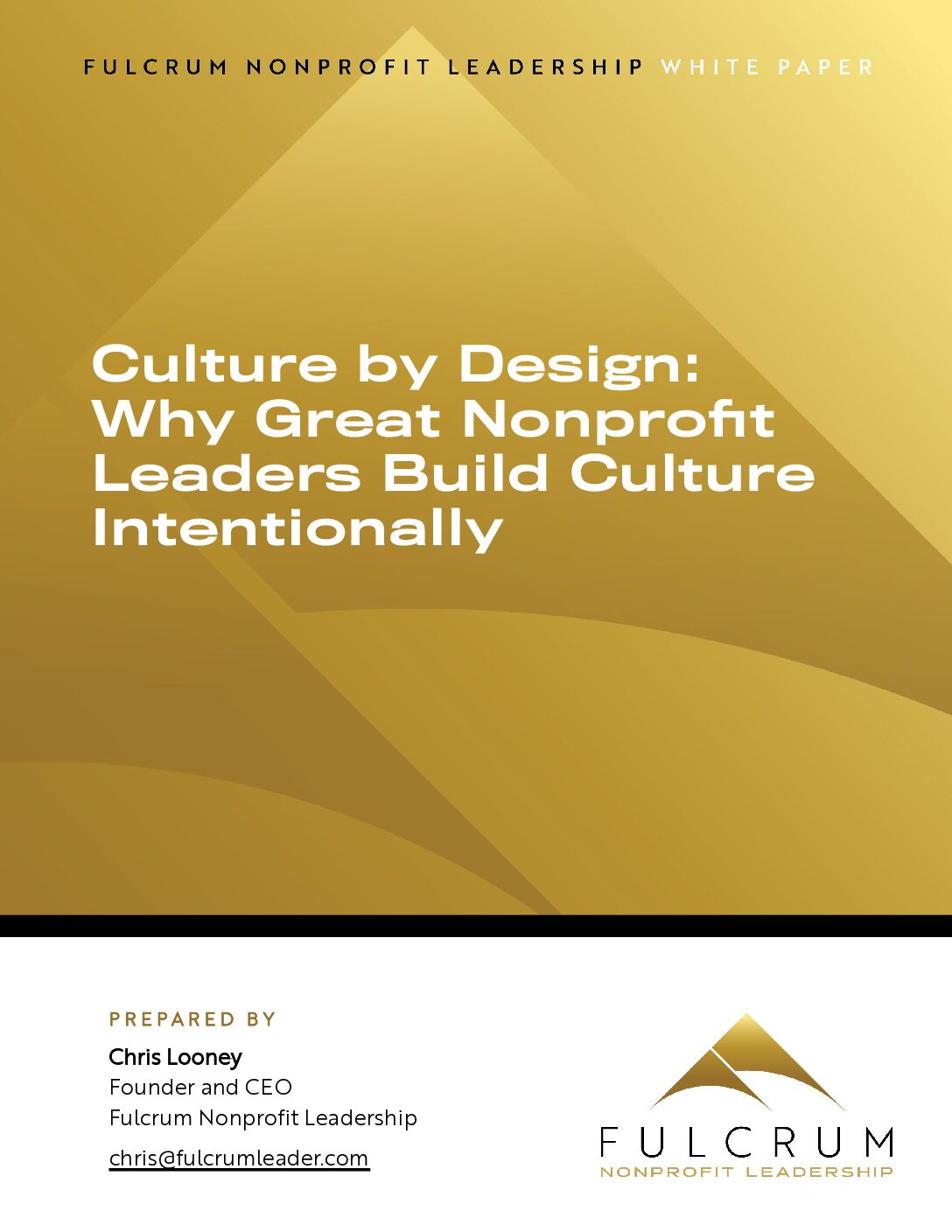
This white paper explores why culture matters so deeply in nonprofit organizations, why responsibility for culture rests squarely with leadership, and how nonprofit leaders can intentionally build and sustain positive, productive cultures.
Decision making sits at the heart of nonprofit leadership. Unlike command-and-control environments, nonprofit leaders operate within ecosystems shaped by mission, values, trust, and accountability to many stakeholders. The most effective decisions are not simply efficient or decisive. They are principled, inclusive, and aligned with purpose.
Nonprofit leadership is rarely lived at the extremes. Most leaders are not trapped in impossible circumstances with no room to move, and they are not operating in environments where every condition is ideal for rapid organizational growth. Instead, leaders spend most of their time in the middle space, where conditions are mixed, constraints are real, and yet meaningful progress is still possible. This is where the philosophy of blooming where you are planted becomes both a mindset and a disciplined practice.
This philosophy does not promise magic. Leaders cannot escape structural realities, financial pressures, or systemic challenges through pure force of will. But it also rejects the fatalistic idea that progress requires perfect soil, abundant sun, or a flawless environment. Growth happens because leaders cultivate it with patience, intention, and the willingness to take the small wins seriously. With the right approach, even imperfect conditions can become fertile ground for improvement.
Nonprofit leaders operate in an environment shaped by mission, community expectations, social responsibility, and the desire to create lasting change. Yet many organizations still struggle to foster cultures where staff feel safe to speak honestly, share concerns, test new ideas, challenge the status quo, or admit when something is not working.
In a time when public discourse often rewards sharp edges and coarseness, nonprofit leadership must hold itself to a higher standard. The work is too important and the stakes too high for cultures where fear, hesitation, or silence become the norm.
Creating safe spaces is not a soft concept. It is a performance strategy. Psychological safety, which is the ability for individuals to express thoughts, questions, and even dissent without fear of embarrassment or retaliation, directly influences organizational health. When leaders establish safe spaces, they set the conditions for innovation, stronger teams, trust, resilience, and mission advancement.
The nonprofit sector is uniquely positioned to model the kind of leadership that values openness, integrity, accountability, and humility. This white paper outlines why safe spaces matter, how they strengthen organizations, and what leaders can do to create environments where people can bring their best thinking to the work.
In public discourse, it is often said that the nonprofit sector stands as a pillar of civil society, sustained by the generosity of donors, the ingenuity of social entrepreneurs, and the selflessness of volunteers. While that image contains truth, it leaves out an indispensable partner: government. The nonprofit sector does not thrive in isolation, nor does it function effectively without a sustained public-private partnership. The history and future of the nonprofit world are deeply intertwined with government at every level. The idea that private philanthropy alone can meet the scale of human need is not only inaccurate but dangerously naive.
In the nonprofit environment, leading through the lens of servanthood is far more than a pleasant aspiration; it is a strategic imperative. The concept of service-first leadership, often termed “servant leadership,” shifts the focus from authority and self-promotion toward empowering others, building capacity, and strengthening community. As nonprofit leaders, embracing this mindset enables your organization to better fulfill mission, enhance stakeholder trust, and sustain impact over time.

For decades, the nonprofit sector has been shaped by a hierarchy that privileges certain functions as “strategic” and others as “support.” Executive leadership, fundraising, and communications often sit at the top of that pyramid, while research, operations, data, and stewardship are relegated to the middle or bottom. It’s time to challenge that hierarchy. If our sector truly believes in collaboration, evidence-based decision-making, and mission alignment, then we must recognize that leadership exists in every corner of our organizations. Some of the most powerful leadership functions are hiding in plain sight — and one of the clearest examples is advancement research.

The latest Fulcrum Point article, “Workplace Exodus: Why Nonprofit Talent Is Walking Away and What We Must Do Now,” examines the growing crisis of burnout, low pay, and inequity driving skilled professionals out of the nonprofit sector. It challenges leaders to move beyond surface solutions and rethink how organizations value and sustain their people. The piece calls for bold reforms in compensation, staffing, equity, and professional development, urging boards and executives to build workplaces where mission-driven talent can truly thrive.

In the nonprofit world, leaders are often surrounded by people giving deeply of themselves—time, energy, emotion, and care. Every task, meeting, and outreach effort draws something from the internal “cup” of staff, volunteers, and even leaders themselves. Over time, that cup empties, leaving fatigue, burnout, and disengagement in its place. The best nonprofit leaders recognize this early and see it as their responsibility not just to refill their own cup, but to fill the cups of others. This is the heart of servant leadership in the nonprofit sector.

In the nonprofit sector, we talk a lot about sustainability, culture, and mission alignment. Yet one of the simplest ways to strengthen all three is often overlooked: promoting from within. Too often, nonprofits bypass their internal talent pipelines in favor of external hires, especially when filling executive roles. This habit may seem harmless, even strategic, but over time it weakens the connective tissue that binds organizations to their people and their communities.

Nonprofit leaders spend a significant portion of their time in meetings—board meetings, staff meetings, donor briefings, and committee sessions. Yet too often, these gatherings drain energy instead of generating it. Running a great meeting is not just a logistical skill; it’s a leadership discipline that reflects an organization’s culture, values, and respect for people’s time. When done well, meetings become a strategic tool to strengthen alignment, accelerate decision-making, and inspire action. When done poorly, they erode engagement and momentum. The difference lies in intentional design and disciplined facilitation.

For generations, religious congregations trained Americans to give regularly and generously, shaping philanthropy as part of everyday life. With 20 million fewer churchgoers today, those habits are eroding, leaving fewer donors and a generation less practiced in generosity. Fulcrum Nonprofit Leadership argues that philanthropy is like a muscle—without consistent training, it weakens. As churches step back from their historic role, new institutions such as colleges, universities, and nonprofits must step forward to cultivate the next generation of givers.
Success in the nonprofit sector often depends less on a single breakthrough and more on the ability to generate and sustain momentum. Momentum is the energy that builds when a nonprofit creates forward motion, experiences small wins, and leverages them into larger victories. In fundraising, this force is particularly powerful: donors respond to progress, campaigns grow when they feel urgent and relevant, and organizations thrive when their leaders know how to cultivate a “snowball effect.”
Nonprofits are built on passion, purpose, and the drive to make a difference. Yet even the most inspiring mission can falter without the right structures to sustain it. As Kenya Beckmann described on the Mastering Fundraising podcast, “Process Protects.” This phrase, credited to her husband, a university professor, captures a fundamental truth: strong systems and processes safeguard organizations from the most significant challenges, barriers, and pitfalls.

In a sector built on mission, meaning, and mentorship, it is remarkable how little we now invest in the long game of leadership development. The nonprofit sector is suffering from a talent gap not because we lack passionate people, but because we have quietly abandoned one of the most effective and time-honored ways of preparing future leaders: apprenticeship.